
Quick verdict
The Dometic CFX2 37L is a strong premium mid-size fridge for road trips and overlanding when one open temperature zone, app control, AC/DC power, and a manageable 37-liter cabinet matter more than an internal battery or dual-zone storage.
This is a research-based review. The site has not physically tested the CFX2 37L for pull-down speed, temperature stability, noise, daily energy use, rough-road durability, or long-term reliability. The conclusions below come from the documented specifications, operating manual, product layout, and comparison with other fridges in the catalog.
The CFX2 37L sits between compact 20- to 30-liter fridges and large 45- to 60-liter models. That is its clearest advantage. It has enough space for a serious two-person food plan but does not impose the weight and floor-area demands of a large dual-zone cabinet. Its single-zone design keeps the interior flexible, and the 12/24V DC plus 100–240V AC inputs support both vehicle operation and pre-cooling at home.
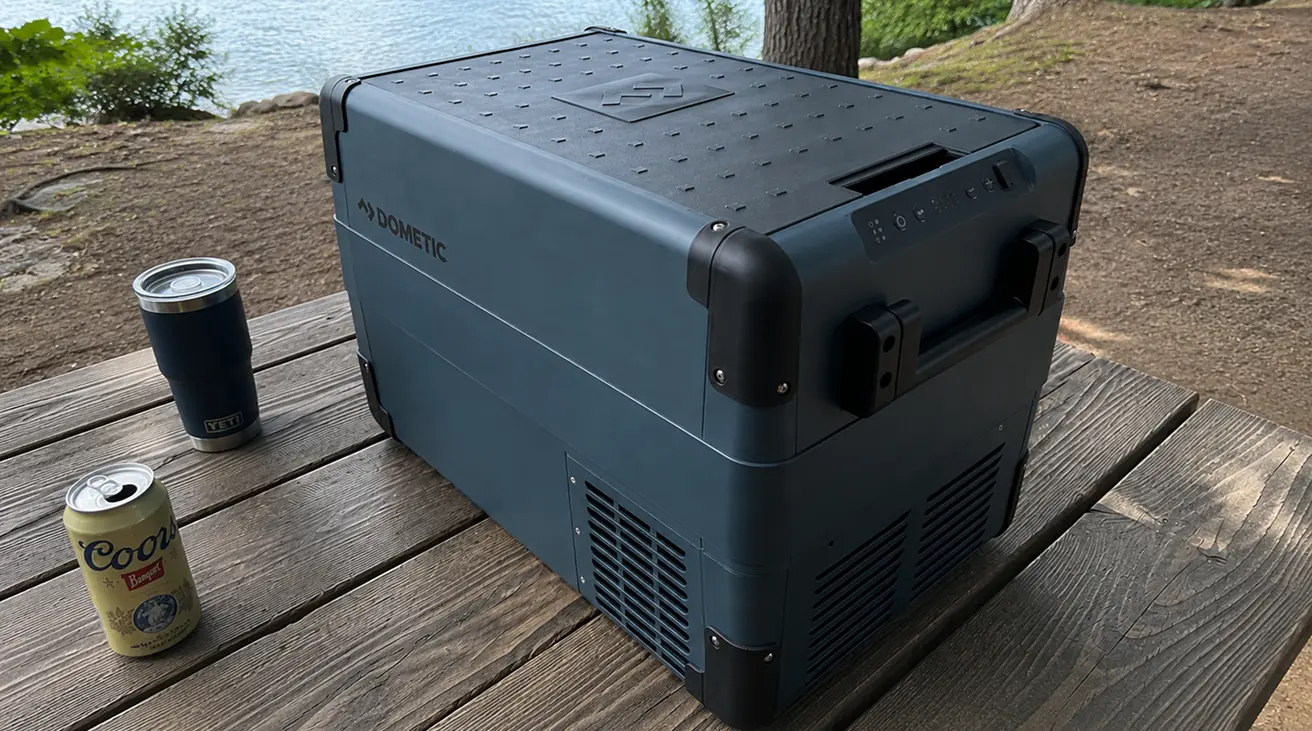
The limitations are equally clear. There is no internal battery, no second temperature zone, and no wheels. The 26.7 × 15.8 × 16.9-inch body is not compact enough to buy without measuring. Buyers who need a freezer compartment, cooling away from the vehicle, or a shallow built-in drawer should choose another form factor.
Dometic CFX2 37L product profile
Product profile
Dometic CFX2 37L Portable Refrigerator and Freezer

A premium mid-size single-zone compressor cooler with vehicle and household power inputs, app control, and a reinforced portable body.
BrandDometic
Cooling
- Capacity
- 37 L (about 39 qt)
- Cooling type
- Compressor
- Zone configuration
- Single zone
- Temperature range
- -7°F to 68°F
Size and fit
- Exterior dimensions
- 26.7 × 15.8 × 16.9 in
- Weight
- 34.8 lb
- Published can capacity
- Up to 48 standard cans
Power and controls
- Power input
- 12/24V DC; 100–240V AC
- Rated current
- 8.7A at 12V; 3.85A at 24VRated current is not the same as average energy consumption.
- Battery protection
- 3-stage
- App control
- Yes
- USB output
- 5V / 2A
- Internal battery
- None
Best for
- Premium mid-size vehicle installations
- Road trips and overlanding with reliable DC or AC power
- Buyers who want app control without moving to a dual-zone cabinet
Not ideal for
- Running away from an external power source without a separate battery
- Keeping frozen and refrigerated items at two temperatures
- Very small cargo areas
Pros
- Practical 37-liter capacity
- Vehicle and household power cables included
- App control and USB charging port
- Three-stage battery protection
- Reinforced portable construction
Cons
- No internal battery
- Single-zone interior
- Larger and heavier than compact 20- to 30-liter models
Key specifications
The product record lists:
- 37-liter capacity, approximately 39 quarts;
- single-zone compressor cooling;
- 26.7 × 15.8 × 16.9-inch exterior;
- 34.8-pound empty weight;
- published temperature range of -7°F to 68°F;
- 12/24V DC and 100–240V AC inputs;
- rated current of 8.7A at 12V and 3.85A at 24V;
- three-stage battery protection;
- app control;
- 5V/2A USB output;
- folding handles and a removable lid;
- no built-in battery and no wheels.
Those figures describe the exact model rather than measured performance in a particular vehicle. Rated current is especially easy to misunderstand. It helps evaluate wiring and source capability, but it is not the average current over a day because the compressor cycles.
Who should buy the CFX2 37L?
The CFX2 37L makes sense for:
- two-person road trips with several days between resupply;
- SUV, crossover, pickup, van, or RV installations with room for a mid-size chest;
- buyers who want app control but not a dual-zone cabinet;
- travelers who can provide reliable vehicle or battery power;
- users who value one open packing space;
- people willing to treat the fridge as a premium appliance rather than a budget cooler.
It is particularly convincing when 20 liters is too restrictive and 50 liters is unnecessary. That middle ground can be difficult to find because product lines often jump from personal-cooler sizes to expedition-style cabinets.
Who should skip it?
Skip the CFX2 37L when:
- refrigerated and frozen food require separate setpoints;
- the fridge must run away from external power without a separate battery;
- the cargo area has less than about 17 inches of closed height plus lid room;
- the fridge must be rolled around camp;
- one person will frequently lift it while fully loaded;
- a shallow drawer is the only layout that fits;
- the trip needs more than 37 liters after packing headroom.
A product can be well designed and still be the wrong size or system. The capacity and fit calculators should come before the brand decision.
Is 37 liters the right capacity?
Thirty-seven liters is a useful mid-size class. It can hold a multi-day refrigerated food plan for two people, or food and drinks for a shorter group trip. The actual result depends on container shape and how many beverages remain cold at once.
The product page may describe a can capacity, but cans do not represent normal camping food. A realistic load includes:
- prepared meal containers;
- dairy and condiments;
- produce;
- meat or alternatives;
- tall bottles;
- flexible bags;
- space needed to access items without unloading the cabinet.
The single open zone helps because there is no divider consuming the center or separating long containers. The compressor step and basket still affect usable shape.
Use the Capacity Planner with days between resupply. If the result is close to 37 liters before headroom, move to a larger model rather than planning to pack the CFX2 completely full.
How well does it fit in a vehicle?
The 26.7-inch length is manageable in many SUVs and vans, while the 15.8-inch width can fit beside other cargo modules. The 16.9-inch height is the dimension most likely to conflict with a cargo cover, shelf, or sleeping platform.
Measure:
- the narrowest hatch or door opening;
- final installed width and depth;
- closed height;
- lid-opening height;
- compressor ventilation from the manual;
- room for the power plug and cable bend;
- strap or tie-down access;
- the route for removing the fridge when empty.
A fridge that fits only with zero clearance is not ready for installation. The Fit Checker can compare the exterior with user-entered ventilation, lid, cable, and mounting allowances.
How heavy is it in practice?
The CFX2 37L weighs 34.8 pounds empty. That is lighter than the 47- to 67-pound large metal fridges, but the loaded weight can still become substantial.
Fifteen liters of drinks alone add roughly 33 pounds. Add food, containers, and a cover, and the fridge can exceed 70 pounds. Plan to load it in the vehicle, carry it with help, or leave it secured for the trip.
The folding handles improve carrying geometry. They do not make a full cabinet light. If frequent movement is part of the plan, a wheeled fridge or a smaller model may be more practical.
Does the single-zone layout help or limit it?
The single-zone layout is one of the CFX2 37L’s strengths for normal road-trip use. The full interior can accept one temperature and irregular containers without a divider.
Choose single-zone when:
- most food is refrigerated rather than frozen;
- large containers need the full width;
- packing changes from trip to trip;
- simplicity matters.
The limitation is that the cabinet cannot hold a refrigerator temperature and freezer temperature at the same time. Running the whole fridge as a freezer is possible within the documented range, but chilled food then needs another place.
If the trip requires two temperatures, compare the ICECO APL35. It offers a similar capacity class with independent zones, at the cost of divided packing space.
How should you interpret the temperature range?
Dometic publishes a range from -7°F to 68°F. That is the controller’s documented range. It is not proof that the fridge will hold the lowest setting in every ambient condition and installation.
Performance depends on:
- ambient heat;
- airflow around the compressor;
- starting food temperature;
- cabinet load;
- direct sun;
- lid openings;
- power stability;
- sensor placement;
- setpoint.
For refrigerated food, use an independent thermometer and organize the cabinet so air can circulate. The setpoint and actual food temperature are related but not identical.
How much power does the CFX2 37L use?
The product record lists rated current rather than a universal Wh/day figure. At 12V, 8.7A corresponds to roughly 104W at the rated condition, but that is not the average daily load. The compressor cycles and operating conditions change the duty cycle.
Do not multiply 104W by 24 hours and assume the fridge consumes 2,496Wh per day. That would treat rated current as continuous consumption.
A useful plan uses one of two inputs:
- measured Wh/day from a similar installation;
- running power or current with a duty-cycle range.
The How Much Power Does a 12V Fridge Use? guide explains the difference. Use the runtime calculator with reserve and connection loss once a daily range is available.
Is app control useful?
App control is useful when the fridge sits behind a seat, under a platform, or deep in an RV bay. It can make setpoint changes and status checks more convenient.
It should not influence the installation more than physical access. The owner still needs to reach:
- the power connection;
- vents;
- lid and basket;
- drain or cleaning areas;
- fuse and cables;
- the fridge for removal and service.
An app also does not prove food safety. An independent thermometer is a better way to monitor actual cabinet conditions.
How useful is three-stage battery protection?
Battery protection allows the fridge to stop at selected input-voltage thresholds. The high setting preserves more source voltage; lower settings permit deeper use.
For a vehicle starting battery, a conservative setting is generally the safer starting point. For a dedicated auxiliary battery, the correct threshold depends on chemistry, battery management, cable loss, and the system design.
The cutoff cannot distinguish a discharged battery from excessive voltage drop. A long cable or loose plug can trigger shutdown while the battery itself remains charged. Measure at the fridge before lowering the protection level.
Can it run from household power?
Yes. The CFX2 37L supports 100–240V AC as well as 12/24V DC. That makes pre-cooling at home straightforward and avoids the need for a separate generic AC-to-DC converter.
Pre-cool the empty cabinet, then load cold food. That reduces the energy the vehicle battery must supply during the first hours of the trip.
At camp, AC operation is convenient when shore power is available. When running from a battery, direct DC normally avoids inverter conversion and idle draw.
Does it need a separate battery?
The fridge has no internal battery. It needs one of these sources:
- vehicle DC while the outlet is live;
- portable power station;
- auxiliary battery;
- household AC;
- inverter or generator through the AC input.
For parked use, a dedicated power source is easier to plan than relying on an unknown starter-battery reserve. The camping power guide outlines the options.
How should it be secured?
Treat the loaded fridge as heavy cargo. Use appropriate vehicle anchors or a rated installation platform. The restraint should control movement without crossing the lid, blocking vents, or straining the power plug.
The folding handles are useful for carrying but should not automatically be assumed to be crash-rated tie-down points. Use the restraint guidance in the manual and the process in How to Secure a Portable Fridge in a Vehicle.
Is the removable lid useful?
A removable lid can simplify cleaning and may help in a constrained installation. It does not eliminate the need for normal opening clearance during daily use.
Before building a platform around it, test:
- how far the lid opens;
- whether removal requires extra side space;
- whether the gasket seats evenly after reinstalling;
- whether a cover affects removal;
- whether the lid can be operated with the straps in place.
How does the CFX2 37L compare with alternatives?
| Option | Capacity | Zone layout | Exterior dimensions | Weight | Power input | Internal battery | App control |
|---|---|---|---|---|---|---|---|
| Dometic CFX2 37L Portable Refrigerator and Freezer | 37 L (about 39 qt) | Single zone | 26.7 × 15.8 × 16.9 in | 34.8 lb | 12/24V DC; 100–240V AC | No | Yes |
| ICECO APL35 37QT Dual-Zone Portable Refrigerator | 37 qt (35 L) | Dual zone | 27.0 × 14.4 × 15.7 in | 32 lb | 12/24V DC; 100–240V AC | No | Yes |
| ICECO VL45 47QT Portable Refrigerator | 47.6 qt (45 L) | Single zone | 27.4 × 15.8 × 19.2 in | Not listed | 12/24V DC; 110–240V AC | Not listed | No |
| BougeRV CRPRO 30QT Portable Refrigerator | 30 qt (about 29 L) | Single zone | 23.0 × 12.6 × 16.2 in | 27.6 lb | 12/24V DC; 110–240V AC | Not listed | Not listed |
| Anker SOLIX EverFrost 2 40L Cooler with Road Trip Kit | 40 L (42 qt) | Single zone | 39.0 × 18.1 × 19.7 in | 56.2 lb | AC, vehicle DC, USB-C, or up to 100W solar | One removable 288Wh LFP battery included | Yes |
ICECO APL35 Dual Zone
Choose the APL35 when two independent temperatures are more important than one open interior. It is a premium compact dual-zone alternative and supports app control. The divided layout is less flexible for large containers.
ICECO VL45
Choose the VL45 when a larger metal single-zone cabinet and simple local controls matter. It is heavier and taller and lacks app control, but its 45-liter capacity suits longer trips.
BougeRV CRPRO30
Choose the CRPRO30 when a smaller, simpler, lower-cost mid-size single-zone fridge is sufficient. It gives up the Dometic’s app and premium details but occupies less capacity and likely less budget.
Anker EverFrost 2 40L
Choose the Anker when the cooler must operate away from an external battery. The included removable battery, wheels, and charging options add mobility, while the long and heavy body requires more cargo space.
What would hands-on testing need to measure?
A proper physical review should record more than whether the fridge becomes cold. Useful tests would include:
- pull-down time from a defined starting temperature;
- 24-hour Wh consumption at several ambient temperatures;
- refrigerator and freezer temperature stability;
- temperature variation between cabinet locations;
- compressor and fan noise at a fixed distance;
- voltage behavior at startup;
- app connection reliability;
- lid, handle, and latch behavior after repeated use;
- loaded carrying effort;
- cleaning and drain access;
- operation inside a measured vehicle installation.
Until those tests are performed, the review should remain clear about the difference between specifications and measured performance.
What stands out?
- The 37-liter capacity fills a useful gap between compact and large fridges.
- Single-zone storage is flexible for normal food packing.
- DC and AC support simplify pre-cooling and travel use.
- App control helps in hidden installations.
- Three-stage battery protection supports different source strategies.
- The reinforced corners, hinges, handles, and removable lid suit repeated travel use on paper.
What may disappoint?
- There is no internal battery.
- The single zone cannot refrigerate and freeze simultaneously.
- The cabinet is too large for some small cars.
- A 34.8-pound empty weight becomes substantial when loaded.
- Premium positioning may not be justified for buyers who do not need app control or the Dometic ecosystem.
- Actual daily energy use still needs measurement or conservative estimation.
Installation checklist
Before ordering:
- estimate food volume;
- measure the hatch and installed space;
- add lid, cable, and ventilation clearance;
- identify cargo anchors;
- plan the DC or AC source;
- estimate parked runtime;
- confirm the physical control and app access;
- decide whether one temperature is enough;
- plan how the loaded fridge will be moved or left installed.
After delivery:
- inspect the cabinet, hinges, gasket, handles, and cables;
- confirm the exact model and included power leads;
- test from household power;
- test from the planned vehicle source;
- monitor voltage during compressor startup;
- compare an independent thermometer with the display;
- perform a 24-hour energy test in the actual installation;
- recheck straps and ventilation after the first trip.
Final verdict
The Dometic CFX2 37L is a well-specified mid-size single-zone fridge for buyers who want app control, broad power compatibility, a practical 37-liter cabinet, and a product designed around frequent vehicle use. Its strengths are balance and integration rather than one extreme feature.
It is not a battery cooler, a dual-zone freezer, or a compact personal fridge. Buyers who need those functions should choose a model built around them rather than forcing the CFX2 37L into the wrong job.
The most important decision is physical fit. If the cabinet, lid, cable, and ventilation work in the vehicle—and one zone covers the food plan—the CFX2 37L is a credible premium choice. If the installation is tight or the trip requires frozen and chilled storage, the alternatives are more appropriate.
FAQ
Is the Dometic CFX2 37L dual-zone?
No. It has one temperature-controlled compartment.
Does the CFX2 37L include a battery?
No. It runs from compatible DC or AC power and requires an external source.
Can it freeze food?
Its published temperature range extends below freezing. Actual performance depends on ambient conditions, ventilation, load, and power.
Is 37 liters enough for two people?
It can be a practical multi-day size for two people, depending on drinks, packaging, and resupply frequency. Use the capacity planner.
Can it run from a vehicle outlet?
It supports 12/24V DC, but the outlet, fuse, wiring, and parked-power behavior must be appropriate for the load.
Is app control necessary?
No. It is useful when the physical panel is hard to reach. Buyers with easy access may prefer a simpler model.
Is it suitable for overlanding?
Its power options, mid-size capacity, reinforced construction details, and battery protection make it a reasonable overlanding candidate. A secure ventilated installation and separate battery plan are still required.
How does it compare with the CFX3 line?
This review covers the exact CFX2 37L product record. Do not transfer dimensions or features from a similarly sized CFX3 model without checking the exact specification.