
Quick answer
If a 12V fridge is draining the car battery, disconnect the fridge before the battery falls further, restore the vehicle to a reliable starting condition, and identify whether the outlet stays live with the engine off. Then compare the fridge’s daily energy use with the battery reserve, low-voltage setting, cable loss, and parked runtime.
The fridge may be working exactly as designed. A 40-watt compressor running part of the night can still consume hundreds of watt-hours. The problem is often not an abnormal appliance load but an unsuitable source: a starter battery that was never meant to support long parked use.
A second group of problems produces similar symptoms. Voltage drop in a long cable can make the fridge stop early. A weak battery can sag under compressor startup. An AC inverter can add conversion and idle losses. A high low-voltage setting can protect the battery but shorten fridge runtime.
The sequence matters. Do not lower protection settings or replace fuses before you know which condition is present.
What should you do before the battery gets any lower?
If the engine is off and the starter battery is being depleted:
- Switch off or unplug the fridge.
- Stop testing accessories from the same battery.
- Do not keep attempting to start the engine if it cranks slowly.
- Restore the battery using the vehicle manufacturer’s approved procedure, roadside support, or an appropriate charger.
- Discard perishable food when its time and temperature history no longer meets food-safety guidance.
A deeply discharged or damaged battery can create more than an inconvenience. It can leave the vehicle stranded and may shorten battery life. The U.S. Department of Energy describes starting-lighting-ignition batteries as high-power batteries used for brief, shallow discharge while normally maintained at a high state of charge.
If the battery is swollen, leaking, unusually hot, frozen, or damaged, stop and follow the battery manufacturer’s safety guidance. This article does not cover battery repair or jump-start procedures.
Fast diagnosis
Start with five observations:
- Did the fridge keep running after the ignition was switched off? If yes, the outlet may be permanently live.
- Did the fridge show a low-voltage error or simply go dark? An error points toward the fridge’s protection threshold or voltage at the plug.
- Did the vehicle start normally before the fridge was used? A weak or partially charged battery has less reserve than its label suggests.
- Was the fridge connected through an inverter? AC conversion may add avoidable loss.
- Did the problem appear after adding an extension cable? Voltage drop or a loose socket can change what the fridge sees.
Also note the parked time, ambient temperature, fridge setpoint, contents, and whether warm food was loaded. These factors affect compressor run time.
Does the vehicle outlet stay powered with the engine off?
Vehicle accessory outlets behave differently. One may switch off with the ignition; another in the same vehicle may remain live. Some stay active for a delay.
Test the exact outlet or consult the owner’s manual. A light on the fridge display is not proof that the alternator is supporting the load. Once the engine stops, a permanently live outlet may be drawing from the starter battery alone.
If the outlet turns off, the battery-drain complaint may involve another connection such as:
- a direct battery lead;
- an always-on cargo socket;
- an auxiliary outlet installed by a previous owner;
- a power station that is being charged from the vehicle while parked;
- an inverter connected to the starter battery.
Trace the actual power path rather than assuming the dashboard socket is responsible.
Is the fridge stopping at its low-voltage threshold?
Portable fridges commonly offer several battery-protection levels. The controller monitors input voltage and switches the compressor off when voltage falls below a threshold.
That protection has two limitations:
- Voltage measured at the fridge can be lower than voltage at the battery because of cable and connector loss.
- A cutoff cannot guarantee enough reserve to start every vehicle under every temperature and battery condition.
A high protection setting tends to stop the fridge sooner. A lower setting allows more discharge. Do not immediately select the lowest level to gain runtime. First identify whether the source is a starter battery, an auxiliary battery, or a power station and follow the fridge and battery instructions.
If the display shows a low-voltage code while the battery appears charged, measure the supply under compressor load through an appropriate diagnostic process. The issue may be at the outlet or cable, not the battery itself.
Is the starter battery fully charged and healthy?
Battery age, temperature, recent short trips, parasitic loads, and charging-system behavior all affect available reserve.
A battery can show a plausible resting voltage and still sag when the fridge compressor starts or when the starter motor is engaged. Voltage alone, measured without load, is not a complete health test.
Warning signs include:
- slower engine cranking;
- repeated need for charging;
- visible corrosion at terminals;
- voltage falling rapidly after the engine stops;
- fridge low-voltage errors much earlier than expected;
- a battery older than the service life typical for its conditions.
Have the battery and charging system tested when starting performance has changed. Do not size a camping load around the printed amp-hour figure of a battery whose condition is unknown.
How long should the battery run the fridge on paper?
Start with energy, not just current.
For a nominal 12V battery:
Rated energy in Wh = amp-hours × nominal voltageA 70Ah battery at 12V contains a nominal 840Wh:
70 Ah × 12 V = 840 WhThat does not mean 840Wh should be used by the fridge. Starter batteries are not intended to be routinely discharged through their full nominal capacity, and starting reserve must remain.
For a separate battery or power station, runtime can be estimated as:
Usable battery Wh ÷ battery-side average fridge load WThe 12V Fridge Runtime Calculator accounts for usable capacity, reserve, efficiency, inverter idle draw, duty cycle, and uncertainty. Use it to test the expected parked period—not to prove that a starter battery will still start the vehicle.
If the estimate says the fridge could consume 400Wh overnight, the conclusion is not “the battery is large enough” until you know how much of that battery is genuinely available for accessory use.
Can cable loss make the fridge draw from a weak supply?
Cable loss does not create energy from nowhere, but it can make the fridge see a lower voltage and operate less reliably.
A long extension, small conductors, a loose accessory socket, corrosion, or a partially inserted plug adds resistance. When compressor current rises, voltage at the fridge can dip enough to trigger protection even when battery voltage is higher.
Look for:
- a plug or socket that becomes warm;
- discoloration or softened plastic;
- a connector that works only when held at an angle;
- repeated low-voltage errors during compressor startup;
- stable operation on a shorter cable;
- a significant voltage difference between the source and fridge under load.
Do not bypass the plug fuse or fit a larger fuse. Repair the weak connection or use a correctly rated, compatible circuit.
Is an AC inverter adding avoidable loss?
A fridge connected through AC from a battery follows this path:
Battery DC → inverter AC → fridge AC adapter → fridgeEach conversion loses energy. The inverter may also consume power while the compressor is off.
A direct compatible DC path is often more efficient:
Battery or power-station DC → fridge DC inputIf a power station is being used, compare its DC-port current limit with the fridge requirement. A large AC inverter rating does not guarantee that the 12V socket supports the same load.
If the fridge only works through its supplied AC adapter, include inverter efficiency and idle draw in the runtime estimate. The detailed options are covered in How to Power a 12V Fridge While Camping.
A step-by-step battery-drain diagnosis
Use this order so one symptom does not lead to an unrelated purchase.
1. Identify the source battery
Confirm whether the fridge is connected to the starter battery, an auxiliary battery, or a portable power station.
2. Confirm outlet behavior
Determine whether the source remains live with the engine off and whether other devices share the circuit.
3. Record the fridge load
Use measured watt-hours per day when possible. Otherwise record running watts, setpoint, approximate duty cycle, and whether the fridge is pulling down a warm load.
4. Calculate the parked energy requirement
Estimate only the hours between charging periods. Include conversion losses and battery reserve.
5. Check the low-voltage setting
Use the product manual to understand the selected protection level. Do not lower it merely to suppress an error.
6. Inspect the connection path
Check the plug, socket, cable, fuse, and any adapter for heat, looseness, damage, and published current limits.
7. Test battery and charging health
When the starter battery is involved, have it and the charging system tested if cranking performance or reserve is uncertain.
8. Separate the camping load
For repeated overnight use, move the fridge to a power source designed and sized for cycling rather than treating the starter battery as a house battery.
Useful connection accessories after the cause is understood
These accessories solve connection-placement problems. They do not make an undersized source safe, repair a weak battery, or increase the current rating of an outlet.
As an Amazon Associate I earn from qualifying purchases.
- Extension cable option for a compatible 12V circuitNOCO GC019 12V Plug 12-Foot Extension CableJump to pick
- Auxiliary-battery socket optionNOCO GC018 12V Socket Adapter with Eyelet TerminalsJump to pick
| Option | Purpose | Connection | Published rating | Important limit |
|---|---|---|---|---|
| NOCO GC019 | Extend a compatible 12V socket | Male plug to female socket | 15 A; 20 A fuse | Extra length can add voltage drop |
| NOCO GC018 | Create a short socket lead from a compatible battery | M10 eyelets to female socket | 15 A; 20 A fuse | Requires a properly designed battery connection |
Extension cable option for a compatible 12V circuit
The NOCO GC019 adds 12 feet of reach between a male 12V plug and female socket. NOCO specifies 16 AWG copper conductors, a 15-amp rating, and a 20-amp inline fuse.
Product profile
NOCO GC019 12V Plug 12-Foot Extension Cable
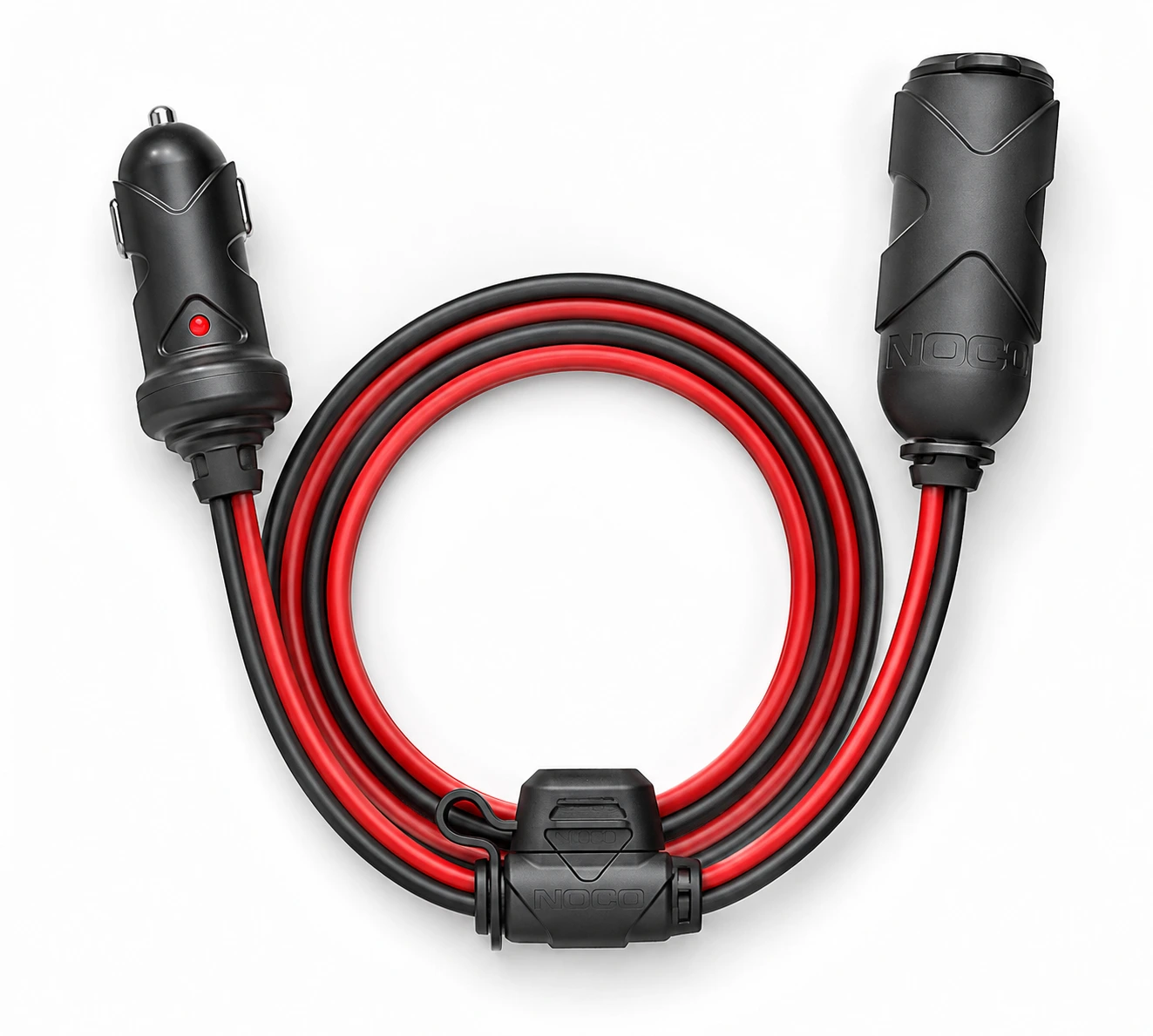
A fused 12-foot male-to-female 12V extension cable for adding reach between a vehicle or battery-powered accessory socket and a compatible portable fridge.
BrandNOCO
Connection
- Model
- GC019
- Input
- 12V male accessory plug
- Output
- 12V female accessory socket
- Cable length
- 12 ft (3.7 m)
Electrical
- Rated current
- 15 A
- Wire gauge
- 16 AWG
- Fuse
- 20 A mini-blade fuse
- Conductor
- Copper
Construction
- Socket protection
- Water-resistant cap
- Power indicator
- LED
- Connection style
- Male-to-female plug and socket
Best for
- Extending a 12V outlet to a portable fridge in a larger vehicle or campsite
- Temporary installations where a direct hardwired connection is not needed
- 12V devices that stay within the cable and outlet current limits
Not ideal for
- Loads above the 15 A cable rating
- Permanent hardwired installations
- Setups where a locking connector is required
Pros
- Adds 12 feet of reach
- Integrated fuse protection
- Water-resistant cap on the female socket
- LED shows when the socket is powered
Cons
- Extra cable length can increase voltage drop
- Uses a non-locking accessory plug and socket
- The vehicle or source outlet must still support the connected load
Use it when the source circuit already supports the fridge and the only problem is location. A longer lead is not the remedy for a warm socket, repeated low-voltage faults, or an outlet with an insufficient rating.
Auxiliary-battery socket option
The NOCO GC018 uses M10 / 3/8-inch eyelets to add a short fused 12V socket lead to a compatible battery terminal arrangement. NOCO lists 16 AWG conductors, a 15-amp rating, and a 20-amp fuse.
Product profile
NOCO GC018 12V Socket Adapter with Eyelet Terminals
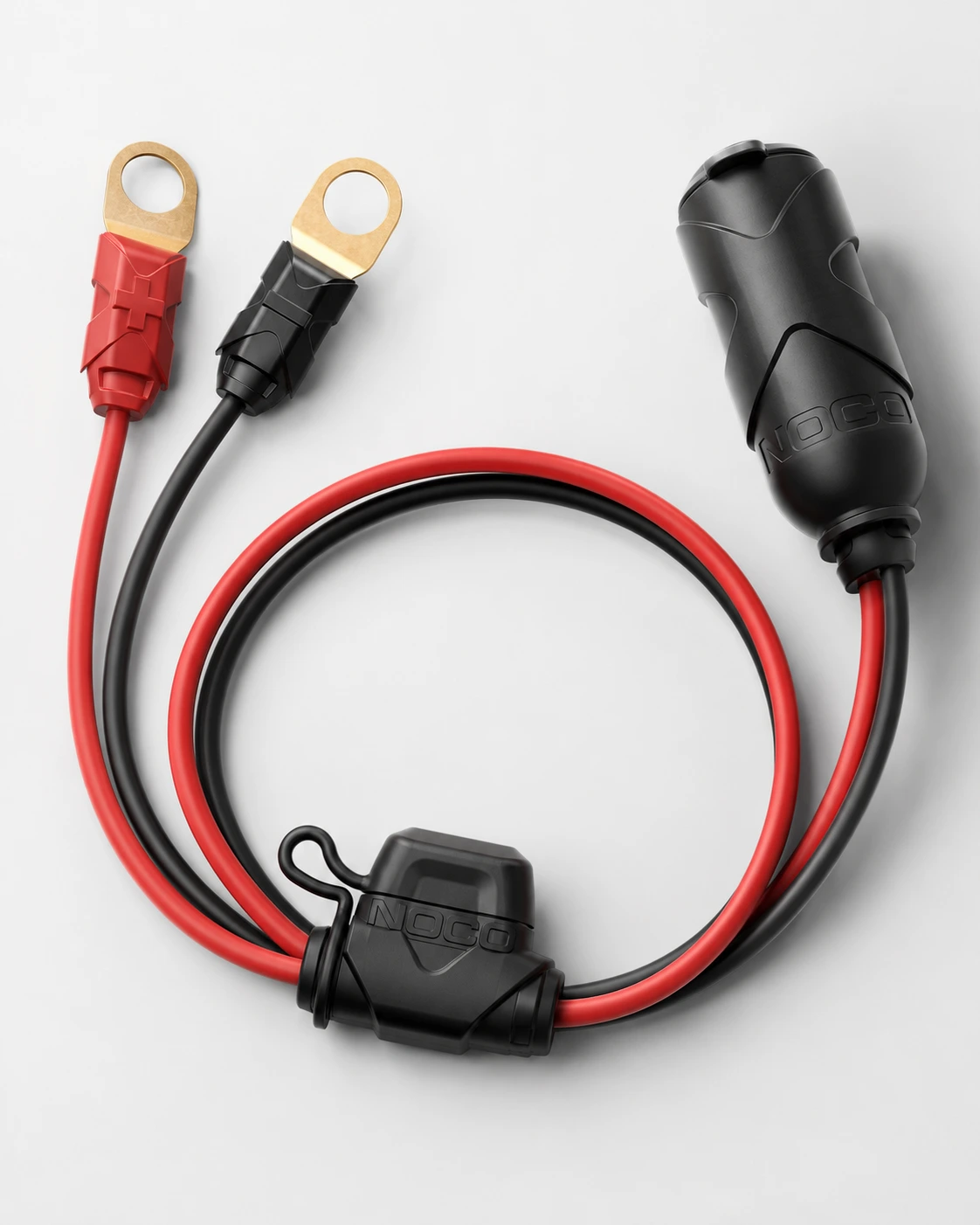
A fused eyelet-to-12V-socket adapter for creating an auxiliary accessory outlet from a compatible 12V battery terminal connection.
BrandNOCO
Connection
- Model
- GC018
- Battery connection
- M10 / 3/8-in eyelet terminals
- Output
- 12V female accessory socket
- Length
- 24 in cable; 28 in overall
Electrical
- Rated current
- 15 A
- Wire gauge
- 16 AWG
- Fuse
- 20 A mini-blade fuse
- System voltage
- 12V
Construction
- Socket protection
- Water-resistant cap
- Installation style
- Fixed eyelet-terminal connection
Best for
- Adding a fused 12V socket to a compatible auxiliary battery
- Portable-fridge setups that need a short fixed battery connection
- Users who can verify terminal size, polarity, fuse placement, and load limits
Not ideal for
- Temporary clamp-on connections
- Battery terminals that do not accept M10 / 3/8-in eyelets
- Loads above the 15 A rating
Pros
- Creates a dedicated 12V female socket
- Integrated fuse protection
- Compact cable length
- Water-resistant socket cap
Cons
- Requires a direct battery-terminal installation
- Not a quick removable clamp connection
- Terminal compatibility and safe routing must be checked before use
This is one component, not an auxiliary-battery design. Charging, isolation, mounting, polarity, conductor protection, and safe routing still need to be resolved for the complete system.
When should you move the fridge to a separate battery system?
A separate system is the sensible direction when:
- the fridge regularly runs with the engine off;
- overnight runtime matters;
- the starter battery has already been depleted once;
- other camping loads share the source;
- the route includes days without long driving periods;
- food safety depends on continuous cooling;
- you need predictable energy accounting.
A portable power station is the simpler option for many occasional campers. A permanently installed auxiliary system can suit frequent travel but requires vehicle-specific design.
The goal is not merely more capacity. It is separating camping energy from the battery that must start the engine.
When should an automotive electrical professional inspect the setup?
Get qualified help when:
- the outlet, plug, or wiring becomes hot;
- fuses repeatedly open;
- the battery drains without the fridge connected;
- the charging warning light appears;
- terminal corrosion or damaged wiring is present;
- a permanent auxiliary battery or new outlet is being installed;
- the vehicle uses a smart charging system you do not understand;
- the proposed load exceeds the published outlet rating;
- voltage drop cannot be traced safely.
Do not continue operating a suspect circuit simply because the fridge turns on intermittently.
FAQ
Why does my 12V fridge drain the battery overnight?
The fridge consumes energy throughout the parked period, and a live outlet may draw directly from the starter battery. Hot weather, freezer use, a warm load, inverter loss, and a weak battery can shorten the time further.
Should low-voltage protection stop the fridge before the car battery dies?
It can reduce discharge, but it cannot guarantee starting reserve for every vehicle. Voltage drop may also cause the fridge to see a different voltage from the battery.
Which battery-protection setting should I use?
Follow the fridge manual and the type of source battery. A higher setting generally stops earlier; a lower setting allows deeper discharge. Do not choose solely for longer runtime.
Can a healthy car battery run a fridge all night?
It may, but “can” is not the same as leaving reliable starting reserve. Starter-battery capacity, condition, temperature, fridge energy use, and parked time all vary.
Why does the fridge show low voltage when the battery reads normal?
Voltage can fall at the fridge under compressor load because of cable resistance, worn sockets, loose plugs, or a weak battery. A resting battery reading does not show the whole circuit behavior.
Does a 12V extension cable drain the battery faster?
The fridge still determines most of the energy use, but added resistance can waste energy and cause voltage drop. Use a correctly rated cable and the shortest practical route.
Is an auxiliary battery the same as a second starter battery?
Not necessarily. Battery chemistry, intended cycling use, charging method, isolation, and system design matter. Choose a system appropriate for repeated accessory loads.
Can I solve the problem by buying a lower-power fridge?
A lower average energy demand can help, but diagnose the source first. A weak battery, always-on outlet, poor connector, or inverter idle load can remain a problem with another fridge.