

Quick verdict
The Dometic CFX2 37L is the most balanced premium single-zone choice for an overlanding vehicle that already has dependable auxiliary power. The ICECO APL35 is the better compact option when two temperatures matter, while the APL55 and VL60 make more sense for long resupply intervals. Travelers who want cooling away from the vehicle should compare the Anker EverFrost 2 and BougeRV Rocky V3.0 before buying a separate power station.
An overlanding fridge has a harder job than a cooler carried from a kitchen to a picnic table. It may remain installed for weeks, share space with recovery gear, operate through hot afternoons, and depend on wiring that runs several feet from a battery. The cabinet must fit when the vehicle is fully packed, the lid must open under shelves or a sleeping platform, and the power connection must survive vibration without becoming a loose high-resistance joint.
That changes what “best” means. A polished control panel is less important than choosing a size that leaves air around the compressor compartment. A removable battery is valuable only when it solves a real off-vehicle use case. A dual-zone model earns its space when the two compartments are large enough for the food plan; otherwise, the divider simply turns one useful interior into two narrow bins.
This guide compares published specifications and design differences. It is not a controlled dust, vibration, energy-use, or long-term durability test. We have not ranked the fridges by claims such as quietest, fastest, or toughest because those conclusions require repeatable field measurements.
How we selected overlanding fridges
We looked for products that answer distinct installation and travel problems rather than filling a list with similar capacities. The main criteria were:
- Installed footprint: width, depth, height, lid travel, cable clearance, and the shape of the cargo area around the fridge.
- Zone layout: one open compartment, fixed dual zones, or a removable divider that can convert the cabinet.
- Power flexibility: direct 12/24V DC, household AC, internal or removable batteries, and app or local controls.
- Handling: empty weight, wheels, handles, lid direction, and whether the fridge is likely to remain mounted.
- Construction details: metal or aluminum bodies, reinforced corners, latches, and features that affect everyday use on rough roads.
- Long-trip practicality: food volume, access while the vehicle is packed, resupply interval, and whether frozen food is genuinely necessary.
None of these criteria replaces installation planning. Enter the exact exterior dimensions in the Portable Fridge Fit Checker and include every clearance stated in the product manual. Then read How to Secure a Portable Fridge in a Vehicle before relying on a handle, cargo loop, or improvised strap path as a restraint point.
We also avoided easy ranking shortcuts. A higher published capacity does not make a fridge more useful when the cabinet blocks a drawer or the compartment shape wastes space. An included battery is not automatically better than an external power station, because the battery may duplicate equipment already in the vehicle. Metal construction can be reassuring in a cargo area, but it also increases lifting weight. App control is convenient when the fridge is buried under gear; it matters much less when the local panel remains within reach. The picks below are therefore organized by the problem each model solves, not by a single score.
Quick picks
As an Amazon Associate I earn from qualifying purchases.
- Best premium single-zone modelDometic CFX2 37L Portable Refrigerator and FreezerJump to pick
- Best compact dual-zone modelICECO APL35 37QT Dual-Zone Portable RefrigeratorJump to pick
- Best large flexible dual-zone modelICECO APL55 55L Dual-Zone Portable RefrigeratorJump to pick
- Best fixed dual-zone metal cabinetICECO VL60 63QT Dual-Zone Portable Refrigerator with CoverJump to pick
- Best integrated battery-and-wheels setupAnker SOLIX EverFrost 2 40L Cooler with Road Trip KitJump to pick
- Best removable-divider battery bundleBougeRV Rocky V3.0 41QT Dual-Zone Refrigerator with 240Wh BatteryJump to pick
- Best straightforward metal single-zone modelICECO VL45 47QT Portable RefrigeratorJump to pick
- Best wheeled single-zone modelICECO JP50 Pro 52QT Portable RefrigeratorJump to pick
Overlanding fridge comparison
| Option | Capacity | Zone layout | Exterior dimensions | Weight | Power inputs | Battery included | App control | Wheels |
|---|---|---|---|---|---|---|---|---|
| Dometic CFX2 37L Portable Refrigerator and Freezer | 37 L (about 39 qt) | Single zone | 26.7 × 15.8 × 16.9 in | 34.8 lb | 12/24V DC; 100–240V AC | No | Yes | No |
| ICECO APL35 37QT Dual-Zone Portable Refrigerator | 37 qt (35 L) | Dual zone | 27.0 × 14.4 × 15.7 in | 32 lb | 12/24V DC; 100–240V AC | No | Yes | Not listed |
| ICECO APL55 55L Dual-Zone Portable Refrigerator | 55 L (58 qt) | Flexible dual zone | 29.7 × 18.9 × 19.3 in | 54.7 lb | 12/24V DC; 110–240V AC | Not listed | Yes | No |
| ICECO VL60 63QT Dual-Zone Portable Refrigerator with Cover | 60 L (63.4 qt) | Fixed dual zone | 31.2 × 19.5 × 18.9 in | About 67.3 lb with cover | 12/24V DC; 110–240V AC | Not listed | No | No |
| Anker SOLIX EverFrost 2 40L Cooler with Road Trip Kit | 40 L (42 qt) | Single zone | 39.0 × 18.1 × 19.7 in | 56.2 lb | AC, vehicle DC, USB-C, or up to 100W solar | One removable 288Wh LFP battery included | Yes | 6 in wheels with retractable handle |
| BougeRV Rocky V3.0 41QT Dual-Zone Refrigerator with 240Wh Battery | 41 qt (39 L) | Flexible dual zone | 28.7 × 17.7 × 15.8 in | 46.8 lb with battery bundle | 12/24V DC; 100–240V AC; 12–32V solar up to 150W | Detachable 240Wh LiFePO4 battery included | Yes | No |
| ICECO VL45 47QT Portable Refrigerator | 47.6 qt (45 L) | Single zone | 27.4 × 15.8 × 19.2 in | Not listed | 12/24V DC; 110–240V AC | Not listed | No | No |
| ICECO JP50 Pro 52QT Portable Refrigerator | 51.7 qt (50 L) | Single zone | 28.5 × 13.8 × 21.0 in | Not listed | 12/24V DC; 110–240V AC | Not listed | Yes | Yes |
Decide where the fridge will live before comparing features
An overlanding fridge is usually part of a system, not a freestanding appliance. The same 37-liter model can be an excellent choice in one vehicle and a constant obstruction in another. Before comparing compressors, apps, or batteries, decide whether the fridge will be:
- permanently secured beside a drawer system;
- mounted on a slide beneath a sleeping platform;
- strapped to an open cargo floor and removed between trips;
- carried outside the vehicle for camp use; or
- shared between two vehicles.
A fixed installation favors a cabinet with accessible power sockets, controls that can be reached when the vehicle is loaded, and a lid that opens without moving other gear. A fridge that leaves the vehicle needs manageable loaded weight, usable handles, and a route through the hatch. Wheels help only after the cabinet reaches the ground; they do not solve the lift over a bumper.
Measure the narrowest opening as well as the final floor space. Tailgates, sloped hatch glass, trim panels, wheel arches, tie-down loops, and drawer latches can reduce the usable opening by several inches. The closed fridge may fit beneath a shelf while its lid cannot open far enough to remove a basket. Cable plugs can add depth, and an insulated cover can add width around a cabinet that was already close to the limit.
The installation should also leave a practical service route. You should be able to unplug the fridge, inspect the connector, clear dust from the ventilation area, remove a basket, and clean a spill without dismantling half the vehicle. A layout that uses every fraction of an inch on paper is usually too tight for real travel.
Best premium single-zone model
The Dometic CFX2 37L is the cleanest fit for an overlanding setup that needs a mid-size cabinet, one uninterrupted storage area, and flexible controls. Its 37-liter interior is large enough for a meaningful food load without crossing into the 55- to 60-liter class that becomes difficult to lift and harder to place beneath shelves.
The exterior dimensions—26.7 × 15.8 × 16.9 inches—are still substantial. The useful comparison is not whether it fits on an empty cargo floor, but whether it fits beside water, recovery gear, drawers, and a sleeping platform. The removable lid can help in a tight installation, yet the cabinet still needs ventilation and access to the power sockets and control panel.
Dometic lists both 12/24V DC and 100–240V AC inputs, app control, a USB output, and three-stage battery protection. The published current figures are electrical ratings rather than average daily consumption. A fridge compressor cycles, and the duty cycle changes with ambient heat, setpoint, food temperature, ventilation, and lid openings. For battery sizing, measured watt-hours per day are more useful than multiplying rated current by 24 hours.
The controls are useful in a built-out vehicle because the fridge does not have to be pulled forward every time the setpoint changes. The app can handle routine adjustments, while the on-unit panel remains the fallback when a phone is unavailable. The USB port is convenient for a small device, but it still draws from the same house battery and should not be treated as extra capacity. Folding handles, reinforced corners, and stainless-steel hinges make the cabinet easier to position and service; they are not certified cargo-restraint points. The removable lid can be an advantage under a low sleeping deck, provided there is a clean place to put it and the seal is not damaged during removal.
The single-zone design is the main advantage and the main limitation. There is no divider consuming space, so wide meal containers and tall bottles are easier to arrange. The same cabinet cannot maintain frozen meat and refrigerated produce at separate temperatures. If that is a non-negotiable requirement, move to the APL35 rather than trying to create a frozen corner inside one controlled zone.
The CFX2 is also a better fit for a tidy electrical installation than for a self-contained camp kitchen. It has no included battery and no wheels. In a vehicle with a fused auxiliary circuit or power station, that omission avoids carrying a second battery system inside the fridge. For someone who regularly moves cold storage to a picnic area, it means another box or cable must follow.
Product profile
Dometic CFX2 37L Portable Refrigerator and Freezer

A premium mid-size single-zone compressor cooler with vehicle and household power inputs, app control, and a reinforced portable body.
BrandDometic
Cooling
- Capacity
- 37 L (about 39 qt)
- Cooling type
- Compressor
- Zone configuration
- Single zone
- Temperature range
- -7°F to 68°F
Size and fit
- Exterior dimensions
- 26.7 × 15.8 × 16.9 in
- Weight
- 34.8 lb
- Published can capacity
- Up to 48 standard cans
Power and controls
- Power input
- 12/24V DC; 100–240V AC
- Rated current
- 8.7A at 12V; 3.85A at 24VRated current is not the same as average energy consumption.
- Battery protection
- 3-stage
- App control
- Yes
- USB output
- 5V / 2A
- Internal battery
- None
Best for
- Premium mid-size vehicle installations
- Road trips and overlanding with reliable DC or AC power
- Buyers who want app control without moving to a dual-zone cabinet
Not ideal for
- Running away from an external power source without a separate battery
- Keeping frozen and refrigerated items at two temperatures
- Very small cargo areas
Pros
- Practical 37-liter capacity
- Vehicle and household power cables included
- App control and USB charging port
- Three-stage battery protection
- Reinforced portable construction
Cons
- No internal battery
- Single-zone interior
- Larger and heavier than compact 20- to 30-liter models
Choose the CFX2 37L when a premium single-zone installation, app access, and a moderate footprint matter more than an included battery. Skip it when cooling must continue away from the vehicle without a separate battery or power station.
Best compact dual-zone model
The ICECO APL35 is the most space-conscious dual-zone model in this group. At 37 quarts and about 32 pounds, it offers two independently controlled compartments without the 50-plus-pound weight and 19-inch height common among large dual-zone cabinets.
That does not mean the APL35 has the packing freedom of a 35-liter single-zone fridge. Each side has its own geometry, and the smaller compartment may become awkward for containers that fit easily in one open basket. Before buying, sketch the actual food plan: frozen packages, produce boxes, bottles, and meal-prep containers. The dual-zone feature is valuable only if both compartments are usable for the items you carry.
The aluminum body, metal latch, supported lid, app control, and SECOP Nano compressor make it a strong candidate for a more deliberate vehicle installation. ICECO also lists compatibility with a separate magnetic battery, but the selected fridge does not include that battery. Treat the optional battery as a separate power purchase, not as part of the base value proposition.
The supported lid is more than a cosmetic detail in a tightly packed vehicle. ICECO lists a holding range of roughly 45 to 110 degrees, so the lid can remain open while a basket is lifted instead of falling against a cabinet or the user’s forearm. The narrow 14.4-inch body can also leave a useful strip of cargo floor beside the fridge. Those benefits are easy to appreciate daily, whereas the dual-zone claim matters only when the food plan truly uses two setpoints. If both sides spend the trip at nearly the same temperature, the divider has reduced packing freedom without adding much practical value.
At 27.0 × 14.4 × 15.7 inches, the APL35 is relatively narrow and lower than the APL55 or VL60. That can help beside drawer systems, although the lid support and controls still need access. Its modest weight is also important when the fridge must be removed between trips; lifting a 32-pound empty cabinet is very different from handling a 60-pound metal model before food is added.
The compact size makes compartment planning more important, not less. If one side is assigned to freezer duty, the remaining refrigerator zone may be too narrow for tall bottles or large leftovers. Buyers who mostly carry refrigerated meals can gain more practical space from a single-zone 35- to 40-liter model even when the advertised capacity is similar.
Product profile
ICECO APL35 37QT Dual-Zone Portable Refrigerator

A lightweight aluminum dual-zone fridge with independent temperature control, a SECOP Nano compressor, and app-based adjustments.
BrandICECO
Cooling
- Capacity
- 37 qt (35 L)
- Cooling type
- SECOP Nano compressor
- Zone configuration
- Two independently controlled compartments
- Operating modes
- Fridge/freezer, freezer/fridge, or matching-temperature operation
- Temperature range
- -4°F to 68°F
Size and construction
- Exterior dimensions
- 27.0 × 14.4 × 15.7 in
- Weight
- 32 lb
- Body
- Aluminum
- Lid support
- Holds at angles from about 45° to 110°
- Latch
- Metal locking latch
Power and controls
- Power input
- 12/24V DC; 100–240V AC
- App control
- Yes
- Cooling modes
- MAX and ECO
- Optional battery
- Compatible with the ICECO PB250 magnetic battery; battery not included
Best for
- Compact dual-zone overlanding setups
- Buyers who want lower weight than many steel dual-zone fridges
- Separating frozen and refrigerated food without a large 50- to 60-liter cabinet
Not ideal for
- Large families or long resupply intervals
- Buyers expecting an included battery
- Packing bulky containers into narrow individual compartments
Pros
- Only about 32 pounds
- Independent dual-zone temperature control
- Durable aluminum body
- SECOP Nano compressor
- App control and supported lid
Cons
- Modest capacity once divided between two zones
- Optional magnetic battery costs extra
- Premium positioning compared with basic plastic single-zone models
Choose the APL35 when two temperatures are necessary but cargo space and lifting weight remain constrained. Choose a single-zone CFX2 or VL45 when one larger compartment would be more useful than two smaller bins.
Best large flexible dual-zone model
The ICECO APL55 is built around flexibility. Its removable divider allows the 55-liter interior to work as two independently controlled compartments or as one larger zone. That is more useful than a fixed divider when trip plans change: frozen meals on one route, a large open refrigerator on another.
Flexibility does not remove the physical cost. The APL55 measures 29.7 × 18.9 × 19.3 inches and weighs 54.7 pounds empty. Once loaded, it should be treated as installed cargo. The cabinet needs a strong base, restraint points that control movement in more than one direction, and enough room for the lid and compressor airflow.
Power ports on both sides can simplify cable routing. Instead of running a cord across a walkway or around a drawer face, the installer can use the side that best aligns with the electrical system. Four USB outputs under DC power may be convenient, but they should not be counted as free energy; every connected device adds load to the same battery system.
This two-sided connection layout is especially helpful when the fridge is mounted between a drawer stack and a vehicle wall. It gives the installer a better chance of keeping the plug out of the aisle and reducing strain at the socket. The published ability to operate at an angle up to 40 degrees is useful context for uneven campsites, but it is not a reason to mount the cabinet permanently on a steep slope. The lid-open and error alerts also have more value in a large fridge: an incompletely latched lid can waste a substantial food load and energy budget before anyone notices.
The removable divider deserves a practical check. Confirm what happens to controls and airflow when the divider is removed, and pack the fridge in both configurations before a remote trip. A theoretically flexible layout can still be awkward if the baskets and compressor hump divide the usable floor in unexpected ways.
This is a strong long-trip option for two or more travelers who genuinely alternate between refrigerator and freezer needs. It is excessive for short solo trips or for a vehicle where the fridge must be carried up steps every evening.
Product profile
ICECO APL55 55L Dual-Zone Portable Refrigerator

A large flexible dual-zone fridge with a removable divider, SECOP compressor, app control, and power connections on both sides of the cabinet.
BrandICECO
Cooling
- Capacity
- 55 L (58 qt)
- Cooling type
- SECOP compressor
- Zone configuration
- Two independently controlled zones or one open compartment
- Divider
- Removable
- Temperature range
- -4°F to 68°F
- Cooling modes
- MAX and ECO
Size and fit
- Exterior dimensions
- 29.7 × 18.9 × 19.3 in
- Weight
- 54.7 lb
- Tilt operation
- Designed to operate at angles up to 40°
Power and controls
- Power input
- 12/24V DC; 110–240V AC
- DC connections
- Ports on both sides of the cabinet
- App control
- Yes
- USB outputs
- Four USB ports when operating on DC power
- Alerts
- Lid-open and error-code alarms
Best for
- Longer overlanding and RV trips
- Travelers who alternate between one large compartment and two zones
- Installations that benefit from power access on either side
Not ideal for
- Frequent lifting by one person
- Small crossovers with limited cargo height
- Buyers who only need a simple compact refrigerator
Pros
- Large flexible interior
- Removable divider and independent controls
- SECOP compressor
- Power ports on both sides
- App control and multiple USB outputs
Cons
- Heavy when empty and considerably heavier when loaded
- No wheels
- Large footprint requires careful lid and ventilation planning
Choose the APL55 when changing between one large compartment and two controlled zones solves a real food-planning problem. Skip it when the extra size and loaded weight would force compromises elsewhere in the vehicle.
Best fixed dual-zone metal cabinet
The ICECO VL60 is the largest and heaviest fridge in this selection. Its 60-liter fixed dual-zone cabinet suits travelers who have already decided that separate frozen and refrigerated storage is worth the footprint. It is not the right model for someone still uncertain about capacity.
The listed dimensions are 31.2 × 19.5 × 18.9 inches, and the selected bundle weighs about 67.3 pounds with its insulated cover. Add food and the installed mass becomes significant. That affects drawer load ratings, mounting hardware, cargo anchors, and how the vehicle behaves over rough surfaces. It also makes casual removal unrealistic for many owners.
The fixed compartments avoid the ambiguity of a removable-divider design. Each side remains a defined space with independent control. The tradeoff is that a large tray, long bottle, or bulky food package cannot cross the divider. Measure the compartment dimensions, not just the total 60-liter claim.
The metal body, SECOP compressor, AC/DC power, and included fitted cover align with a long-term vehicle installation. There is no app control in the current product record, which may be a benefit for users who prefer local operation. It is a drawback when the control panel is difficult to reach once the vehicle is loaded.
The included cover is useful protection in a cargo bay, but it should be treated as part of the installed dimensions. Fabric can add just enough width to interfere with a drawer or enough height to rub a shelf, and any opening around the compressor must remain aligned. The 0°F published minimum is also worth noting. It covers ordinary frozen-food storage for many trips, yet buyers seeking a lower setpoint should not assume this model matches fridges listed to -4°F or -7°F. The VL60’s advantage is not the lowest number on a specification sheet; it is a large, clearly divided cabinet that can keep one zone off when the trip no longer needs both.
Because one zone can be switched off, the VL60 does not always need to operate as a full two-compartment system. That can be useful after part of the food supply has been consumed. It does not make the fridge physically smaller, and it does not remove the need to restrain a heavy loaded cabinet.
Product profile
ICECO VL60 63QT Dual-Zone Portable Refrigerator with Cover

A heavy-duty 60-liter metal dual-zone refrigerator with independent controls, a SECOP compressor, and a model-specific insulated cover in the selected bundle.
BrandICECO
Cooling
- Capacity
- 60 L (63.4 qt)
- Cooling type
- SECOP compressor
- Zone configuration
- Two independently controlled fixed zones
- Zone operation
- Either zone can be switched off
- Temperature range
- 0°F to 50°F
- Cooling modes
- MAX and ECO
Size and construction
- Exterior dimensions
- 31.2 × 19.5 × 18.9 in
- Weight
- About 67.3 lb with cover
- Shell
- Metal cabinet with reinforced corners
- Storage
- Two removable wire baskets
- Lighting
- Interior lights
Power and included equipment
- Power input
- 12/24V DC; 110–240V AC
- App control
- No
- Included cover
- Model-specific insulated protective cover
- Tilt operation
- Designed to operate at angles up to 40°
Best for
- Long overlanding trips with substantial chilled and frozen storage
- Pickup, trailer, and RV installations with enough floor space
- Buyers who prefer a durable metal cabinet and fixed independent zones
Not ideal for
- Frequent removal from the vehicle
- Small cargo areas
- Users who need temperatures below 0°F or app control
Pros
- Large independent dual-zone capacity
- Heavy-duty metal construction
- SECOP compressor
- One zone can be switched off
- Insulated cover included
Cons
- Very heavy before food is added
- Large installation footprint
- No app control
- Published minimum setting is 0°F rather than -4°F
Choose the VL60 when a large fixed dual-zone layout is already part of the vehicle plan and the installation can support its loaded mass. Do not choose it simply because 60 liters sounds safer than 40; unused capacity still consumes cargo space every day.
Best integrated battery-and-wheels setup
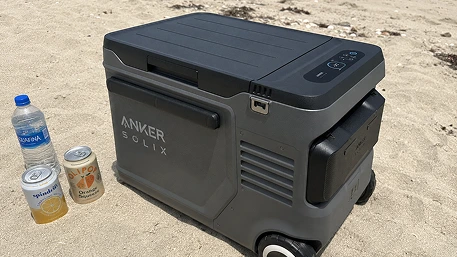
The Anker SOLIX EverFrost 2 40L changes the overlanding power equation. The selected Road Trip Kit includes a removable 288Wh LFP battery, and the cooler can also accept vehicle DC, household AC, USB-C, or compatible solar charging. For travelers who move the cooler between the vehicle, camp kitchen, and day-use area, that integrated battery is easier to manage than a separate power station and loose cable bundle.
Mobility is the reason to consider it, but the cabinet is not compact. At 39.0 × 18.1 × 19.7 inches and 56.2 pounds, it is the longest product in this group. Six-inch wheels and a retractable handle help on firm ground, yet they do not make the cooler easy to lift over a bumper or through a narrow hatch. The long body also needs space to turn when rolling.
The 40-liter interior is single zone. Anker offers larger dual-zone models in the product family, but this exact 40L variant follows one setpoint. The included battery can keep cooling active while the engine is off, but manufacturer runtime claims depend on stated conditions. Hot ambient air, freezer operation, warm food, and frequent opening can shorten that figure considerably.
The removable 288Wh LFP pack is best understood as a bridge between power sources, not an unlimited substitute for them. It can cover a lunch stop, an evening away from the vehicle, or the interval between unplugging at home and connecting at camp. Vehicle DC can recharge while driving, AC can handle campground or hotel stops, USB-C can be useful when compatible equipment is already carried, and the listed solar input provides another route during daylight. A robust trip plan still asks how many watt-hours the cooler consumes on the hottest day and how quickly the available source can replace them.
This model makes the most sense when the battery solves a recurring use case: picnic stops, a tent kitchen away from the vehicle, or moving cold storage between vehicles. If the fridge will remain bolted beside an auxiliary battery, an integrated battery and wheels may add cost and bulk without solving a real problem.
The removable battery also changes charging logistics. A driver can charge the cooler from vehicle DC while moving, top it up from AC at a campground, or use compatible solar input during a longer stop. The plan still needs a margin for cloudy weather, shade, cable limitations, and the fact that charging and cooling can compete for the same available input.
Product profile
Anker SOLIX EverFrost 2 40L Cooler with Road Trip Kit

A wheeled 40-liter single-zone compressor cooler with an included removable 288Wh battery and charging options for AC, a vehicle socket, USB-C, or solar.
BrandAnker SOLIX
Cooling
- Capacity
- 40 L (42 qt)
- Zone configuration
- Single zone
- Temperature range
- -4°F to 68°F
- Cooling modes
- MAX, ECO, and Smart
- Published fast-cooling claim
- 77°F to 32°F in 15 minutesManufacturer test used an empty cooler in MAX mode at 77°F ambient.
Battery and charging
- Included battery
- One removable 288Wh LFP battery
- Published runtime claim
- Up to 52 hours at 39°F with one batteryManufacturer test used an empty cooler in ECO mode at 77°F ambient; real runtime varies.
- Charging options
- Wall outlet, vehicle socket, USB-C, or up to 100W solar
- Solar input
- 12–30V; a battery must be installed while solar charging
- App control
- Yes
Size and mobility
- Exterior dimensions
- 39.0 × 18.1 × 19.7 in
- Weight
- 56.2 lb
- Mobility
- 6 in wheels and retractable EasyTow handle
- Water resistance
- IPX3
- Selected bundle
- 40L cooler, removable battery, and Road Trip Kit
Best for
- Trips where cooling must continue away from a parked vehicle
- Campers who want an included removable battery
- Buyers who value wheels, app control, and several charging methods
Not ideal for
- Small trunks or narrow cargo bays
- Buyers needing two independently controlled zones
- Frequent lifting into tall vehicles
Pros
- Included 288Wh removable battery
- Four charging methods
- Wheels and retractable handle
- App control
- Wide temperature range and three cooling modes
Cons
- Wide and heavy compared with conventional 35- to 40-liter fridges
- Single-zone interior
- Published runtime depends strongly on test conditions
- A second battery is not included
Choose the Anker when off-vehicle operation and roll-away mobility are central to the trip. Choose an externally powered chest fridge when the cooler will remain installed and every inch of cargo length matters.
Best removable-divider battery bundle
The BougeRV Rocky V3.0 41QT sits between a conventional dual-zone fridge and a battery-powered cooler. Its removable divider can create two controlled compartments or open the 39-liter cabinet into one larger space. The selected bundle includes a detachable 240Wh LiFePO4 battery.
At 28.7 × 17.7 × 15.8 inches, it is shorter and more compact than the Anker. The 46.8-pound bundle is still heavy enough that an installed position is preferable. Unlike the Anker, it has no wheels, so removing it means lifting the full cabinet and battery.
The listed power options include 12/24V DC, household AC, and compatible solar input. App control and a removable divider add convenience, but the 80-watt rated power should not be treated as constant consumption. Battery runtime depends on how often the compressor runs and whether the two compartments are maintaining different setpoints.
Compared with the Anker, the Rocky uses a more conventional chest-fridge footprint. It is shorter and easier to place under some cargo systems, although the 46.8-pound bundle still deserves a fixed or semi-fixed location. Two removable baskets can make a divided load easier to organize, and the divider can be removed when a single wide compartment is more useful. The included 240Wh LiFePO4 pack and solar input up to 150W give the system several charging paths, but the cooler has no wheels. A buyer who expects to carry it away from the vehicle should rehearse that lift with an equivalent loaded weight before assuming the battery makes it a portable camp box.
The Rocky earns its place for travelers who want an included battery but do not want the Anker’s extra length and rolling chassis. Its newer platform also has a shorter public track record than long-established lines such as the ICECO VL series. That is a reason for cautious expectations, not a factual conclusion about reliability.
The 240Wh battery is smaller than the Anker’s 288Wh pack, yet nominal capacity alone does not decide real runtime. Cabinet insulation, duty cycle, ambient temperature, setpoints, divider use, and charging losses all matter. Compare the complete operating pattern rather than treating battery size as a winner by itself.
Product profile
BougeRV Rocky V3.0 41QT Dual-Zone Refrigerator with 240Wh Battery

A 39-liter removable-divider fridge bundled with a detachable 240Wh battery, app control, and inputs for vehicle, household, or compatible solar power.
BrandBougeRV
Cooling
- Capacity
- 41 qt (39 L)
- Cooling type
- Compressor
- Zone configuration
- One open compartment or two zones with the divider installed
- Divider
- Removable
- Temperature range
- -4°F to 68°F
Battery and power
- Included battery
- Detachable 240Wh LiFePO4 battery
- Published runtime claim
- Up to 20 hours under specified conditionsRuntime depends on ambient temperature, setpoint, load, openings, and operating mode.
- Power input
- 12/24V DC; 100–240V AC; 12–32V solar up to 150W
- Rated power
- 80W
- App control
- Yes, with a published range up to about 32 ft
Size and construction
- Exterior dimensions
- 28.7 × 17.7 × 15.8 in
- Weight
- 46.8 lb with battery bundle
- Body
- Metal and plastic
- Baskets
- Two removable baskets
- Published noise level
- 45 dB or less
Best for
- Battery-supported overlanding without moving to a very wide cooler
- Travelers who want single- or dual-zone packing
- Users who may recharge from vehicle, AC, or compatible solar power
Not ideal for
- Buyers seeking a lightweight compact cooler
- Frequent one-person lifting
- Trips where a fixed single-zone interior is simpler
Pros
- Detachable 240Wh battery included
- Flexible single- or dual-zone layout
- Vehicle, household, and solar input options
- App control
- Two removable baskets
Cons
- Heavy for a 39-liter fridge
- No wheels
- Published runtime is conditional
- Newer product with a shorter long-term track record
Choose it when a compact removable-divider layout and included battery fit the trip. Skip it when wheels are essential or when a proven single-zone cabinet would provide more useful interior space.
Best straightforward metal single-zone model
The ICECO VL45 is a simpler overlanding choice: one 45-liter compartment, a metal body, a SECOP compressor, substantial side handles, and no app layer. That simplicity suits a permanent vehicle installation where the control panel remains accessible.
Its 27.4 × 15.8 × 19.2-inch cabinet is tall relative to the CFX2 37L and APL35. The height can conflict with cargo covers and sleeping decks, so the Fit Checker should include lid-opening room rather than only closed dimensions. The metal shell and side handles make the fridge feel more installation-oriented than a light picnic cooler, but published construction alone does not prove resistance to repeated vibration.
The temperature range in the product record is narrower than several newer models, at 0°F to 50°F. That still covers normal refrigerator and freezer use, provided the actual installation conditions allow the fridge to reach and hold the setpoint. There is no internal battery, no app, and no wheels. Those omissions reduce complexity but shift more responsibility to the vehicle’s power and layout.
The open 45-liter compartment is the practical reason to choose it. A broad meal container, produce box, or group of tall bottles can use the interior without negotiating a divider. The interior drain helps after a spill or defrost, and the heavy-duty side handles are useful when positioning the empty cabinet. Once loaded, however, those handles should be viewed as carrying aids rather than a plan for daily removal. The 19.2-inch height is the bigger fit issue: it can work well in an open pickup bed or tall SUV while becoming impossible beneath a drawer top or sleeping deck.
A fitted insulated cover is available for the VL45. If used, include the cover in the final footprint and keep every vent opening aligned. An insulated cover cannot compensate for blocked airflow.
The VL45 is easier to understand than many feature-heavy alternatives. That can be an advantage on a long route: local controls, a single zone, and no removable battery ecosystem. The tradeoff is that every power interruption depends on the vehicle or external battery, and every temperature change requires reaching the fridge itself.
Product profile
ICECO VL45 47QT Portable Refrigerator

A metal-bodied single-zone 45-liter fridge with a SECOP compressor, substantial handles, and a layout aimed at overlanding and long-term vehicle use.
BrandICECO
Cooling
- Capacity
- 47.6 qt (45 L)
- Cooling type
- SECOP compressor
- Zones
- Single zone
- Temperature range
- 0°F to 50°F
Size and construction
- Exterior dimensions
- 27.4 × 15.8 × 19.2 in
- Body
- Metal shell
- Handles
- Heavy-duty side handles
- Drain
- Interior drain
Power and controls
- Power input
- 12/24V DC; 110–240V AC
- App control
- No
- Display
- On-unit digital control panel
Best for
- Overlanding and long-term vehicle installations
- Buyers who prefer a metal-bodied fridge
- Medium-to-large single-zone storage
Not ideal for
- Frequent carrying by one person
- Very tight cargo spaces
- Independent refrigerator and freezer temperatures
Pros
- SECOP compressor
- Rugged metal construction
- Large 45-liter single-zone interior
- Strong side handles
Cons
- Heavy and bulky compared with plastic compact models
- No wheels
- Single-zone only
Choose the VL45 when a durable-looking single-zone cabinet and local controls suit the build. Choose the CFX2 when app control and a lower, lighter mid-size package matter more.
Best wheeled single-zone model
The ICECO JP50 Pro is a practical choice for a fridge that sometimes remains installed and sometimes rolls into camp. Its 50-liter single-zone capacity, wheels, pull handle, multi-directional lid, app control, and included cover address everyday handling more directly than most metal chest fridges.
The cabinet is narrow at 13.8 inches but tall at 21.0 inches. That shape can fit beside other cargo while failing under a low shelf or tonneau cover. The multi-directional lid helps when access changes, but the surrounding structure must still leave room for the chosen opening direction.
A 50-liter single-zone fridge suits a group that values one large packing area. It is less suitable when frozen food must remain separate from refrigerated items. The wheel system also deserves context: it helps on pavement and hard-packed ground, but the pull handle does not make a loaded 50-liter fridge pleasant on rocks, steps, or deep sand.
Its unusually narrow 13.8-inch width can be an advantage in a long cargo bay because the fridge occupies less side-to-side space than many 50-liter models. The cost is a 21-inch height, which can place the lid above a window line or beneath a shelf where access becomes awkward. The multi-directional lid gives the installer choices that a fixed hinge cannot: it may open away from a seat, drawer, or wall as the layout changes. App control is also more useful here than on an exposed picnic cooler because the tall cabinet may be positioned where the local panel is inconvenient to read.
The included cover can reduce scuffs and direct heat exposure. It adds bulk, and it must not obstruct the compressor ventilation area. Because the product record does not include a measured daily energy figure, battery planning should use a wide range until consumption is recorded in the actual installation.
The multi-directional lid is particularly useful in a vehicle whose packing layout changes. It can reduce the need to rotate the entire fridge when a cabinet, seat, or wall blocks one side. It does not solve height, so measure the open-lid envelope in every orientation you expect to use.
Product profile
ICECO JP50 Pro 52QT Portable Refrigerator

A wheeled 50-liter single-zone fridge with a SECOP compressor, pull handle, multi-directional lid, and included protective cover.
BrandICECO
Cooling
- Capacity
- 51.7 qt (50 L)
- Cooling type
- SECOP compressor
- Zones
- Single zone
- Temperature range
- -4°F to 68°F
Size and handling
- Exterior dimensions
- 28.5 × 13.8 × 21.0 in
- Wheels
- Yes
- Pull handle
- Yes
- Lid
- Multi-directional opening
- Protective cover
- Included
Power and controls
- Power input
- 12/24V DC; 110–240V AC
- App control
- Yes
- Compressor tilt rating
- Designed to operate on inclines up to 40°
Best for
- Longer camping and overlanding trips
- Users who want wheels and a pull handle
- Large single-zone food or freezer storage
Not ideal for
- Small vehicles
- Low-height cargo areas
- Dual-zone use
Pros
- SECOP compressor
- Wheels and pull handle
- Multi-directional lid
- Protective cover included
Cons
- Tall and bulky
- Single-zone only
- Requires careful cargo-opening and lid-clearance measurements
Choose the JP50 Pro when a large single-zone fridge needs to roll between vehicle and campsite. Choose a fixed dual-zone model when separate temperatures matter more than mobility.
Match the fridge strategy to the vehicle and route
These eight picks fall into three useful strategies. A mid-size externally powered single-zone fridge such as the CFX2 or VL45 is the simplest choice for a vehicle with a reliable auxiliary electrical system. It gives the most flexible packing area and avoids carrying another battery inside the appliance. A compact or large dual-zone model such as the APL35, APL55, or VL60 makes sense when frozen food is planned from the beginning and the two compartments can be packed deliberately. Battery-equipped systems such as the Anker and Rocky solve a different problem: they keep cooling active when the fridge leaves the vehicle or when the vehicle is parked without a permanent house battery.
Vehicle size alone does not decide among them. A pickup with a tall canopy may handle the VL60’s height but still lack a comfortable way to lift it. A midsize SUV may fit the APL35 beside drawers but leave too little room for a week’s food. A van with a strong electrical system may benefit more from the simple VL45 than from a battery cooler that duplicates an existing power bank. Start with the route, resupply pattern, installation, and charging plan, then use the product features to refine the choice.
How much capacity does an overlanding trip need?
Overlanding capacity is better estimated from days between resupply than from total trip length. A two-week route with grocery access every three days can use a smaller fridge than a five-day remote route carrying all meals from the start.
Plan the cold load in four groups:
- drinks that must remain cold;
- perishable food for each day between resupply;
- frozen food that cannot share a refrigerator setpoint;
- shared extras such as condiments, meal containers, medicine, or ice packs.
Then add headroom for container shape and access. A fridge packed to the lid may have the nominal volume but become frustrating at every meal. The Portable Fridge Capacity Planner gives a transparent starting point and rounds the result to a shopping range.
Do not use can-count claims as the only capacity measure. Standard cans pack more efficiently than real food containers, and a dual-zone divider changes the usable shape. Photograph or list the containers used on a typical trip, then compare their dimensions with the baskets and compartment openings of the exact fridge.
Single zone or dual zone for overlanding?
Choose single zone when:
- most food can remain at one refrigerator temperature;
- wide containers and flexible packing matter;
- the vehicle has limited external space;
- a separate small freezer is unnecessary;
- simplicity and lower weight are priorities.
Choose dual zone when:
- frozen food is part of the route plan;
- the resupply interval is long;
- two people need clearly separated storage;
- the compartments are large enough for the actual containers;
- the power system can support the more demanding operating scenario.
A removable divider offers flexibility, but it should be evaluated as two different layouts. Compare the dimensions and controls with the divider installed, then compare the open-compartment mode. The full explanation is in Single-Zone vs Dual-Zone Portable Fridges.
How should an overlanding fridge be powered?
A reliable setup usually separates the fridge from the starter battery. Common approaches include a fused auxiliary battery circuit, a portable power station with a stable DC output, or a battery-equipped cooler. The correct choice depends on the vehicle, charging method, parking duration, and whether the fridge operates away from the vehicle.
Direct DC is often the simplest path because it avoids inverter conversion. That does not make every cigarette-lighter outlet suitable. Some outlets switch off with the ignition, some share a circuit with other accessories, and some develop enough voltage drop that the fridge reaches its low-voltage cutoff while the battery still appears charged.
Use the 12V Fridge Runtime Calculator with a measured Wh/day figure whenever possible. If only running watts are available, estimate duty cycle conservatively and test the setup before a remote trip. The separate guide on how much power a 12V fridge uses explains why a 45-watt rating is not the same as 1,080Wh every day.
A battery-equipped cooler can simplify short off-vehicle stops, but it does not remove the charging problem. The battery must still be replenished from DC, AC, USB-C, or solar. Build the plan around the least reliable charging day, not the best published runtime.
What construction details matter on rough roads?
Metal or aluminum panels, reinforced corners, supported lids, and strong latches can make a fridge easier to live with in a packed vehicle. They do not automatically prove that the internal refrigeration system will tolerate any road or mounting angle. Follow the manufacturer’s operating and transport guidance for the exact model.
Look closely at:
- whether handles are designed for carrying or restraint;
- how the lid hinge is protected when the fridge moves;
- whether a power plug protrudes into the cargo path;
- how baskets and dividers are retained;
- whether controls can be damaged by neighboring gear;
- whether the compressor ventilation area faces a wall or soft bag;
- how the drain plug can be reached after installation.
A fitted cover can reduce scuffs and sun exposure, but it must match the model and preserve airflow. A loose universal cover can fold across a vent, cover a control panel, or shift under straps.
How should the fridge be secured?
A loaded 50-liter fridge can weigh far more than its empty specification. Restraint should control forward, rearward, and lateral movement without crushing the cabinet or blocking the lid. Use vehicle cargo anchors and manufacturer-provided tie-down points where available. Do not assume plastic handles are rated as crash restraints.
After installation:
- load the fridge as it will be used;
- pull it firmly in every direction;
- confirm the straps cannot slide into the lid seal;
- inspect cable slack and plug strain;
- open the lid fully;
- check the installation again after the first rough section of road.
The detailed procedure is in How to Secure a Portable Fridge in a Car, SUV, or Truck.
Common overlanding fridge mistakes
- Buying the largest capacity that fits an empty cargo floor.
- Ignoring loaded weight when choosing a slide or anchor.
- Treating a handle as a certified restraint point.
- Using a dual-zone fridge without planning what fits in each compartment.
- Blocking compressor ventilation with a cover, drawer, or soft bag.
- Assuming an included battery will last the full trip without a charging plan.
- Using rated watts as daily energy consumption.
- Depending on one vehicle outlet without testing whether it stays live when parked.
- Mounting the fridge where the lid, drain, controls, or cable cannot be reached.
- Packing warm food immediately before a long stationary period and expecting normal holding consumption.
FAQ
Is a metal fridge automatically better for overlanding?
No. Metal or aluminum construction can reduce surface damage and provide a more installation-oriented cabinet, but it also adds weight. Compressor quality, ventilation, restraint, electrical stability, and service access remain important.
How large should an overlanding fridge be for two people?
Many couples can work within roughly 30 to 45 liters when resupply is frequent and drinks are limited. Longer remote intervals, frozen food, or bulky containers can justify more. Use the capacity planner with your actual days between resupply rather than choosing by traveler count alone.
Do I need dual zone for a long trip?
Only when frozen and refrigerated storage must be maintained at the same time. A large single-zone fridge can be easier to pack and may provide more useful room for irregular containers.
Can I run an overlanding fridge from the starter battery?
It may be technically possible, but prolonged parking can leave insufficient energy to start the vehicle. A tested auxiliary power plan and suitable low-voltage protection are safer than relying on a generic runtime estimate.
Is an integrated-battery cooler better than a fridge plus power station?
It is cleaner and easier to move as one system. A separate power station is more flexible because it can power other devices and can be replaced independently. Compare total capacity, charging inputs, weight, and where the cooler operates.
Should an insulated cover stay on all the time?
Only when it fits the exact model and keeps all ventilation openings clear. Include the cover in fit measurements and inspect it after travel because fabric can shift around vents or plugs.
Can a fridge run while the vehicle is moving on rough roads?
Portable fridges are commonly used in vehicles, but installation, angle, vibration, power stability, and securing requirements vary by model. Follow the product manual and test the complete installation before a remote route.