

Quick verdict
Choose a single-zone fridge when one temperature works for the whole trip. Choose dual-zone only when you will genuinely use two different temperatures at the same time. Two zones add control, but they divide the interior, increase exterior size for a given usable compartment, and make packing less forgiving.
Dual-zone sounds like the automatic upgrade. It is not. A fridge with two controlled compartments can keep food frozen on one side and refrigerated on the other, but that flexibility has a physical cost: dividers, separate lids or openings, extra control hardware, and small compartments that may not fit bulky containers.
The better question is not “Which design is more advanced?” It is “What temperatures do my actual contents require?”
Single-zone vs dual-zone at a glance
| Option | Single-zone | Dual-zone |
|---|---|---|
| Temperature control | One setpoint for the full interior | Two independently controlled compartments on true dual-zone models |
| Packing flexibility | One open space accepts larger containers more easily | Divider and compartment shapes restrict some items |
| Fridge and freezer at once | Not with one controlled compartment | Yes, when the exact model supports independent zones |
| Exterior size | Often smaller for the same open storage volume | Often larger or less space-efficient because of the split layout |
| Controls | One temperature setting | Two setpoints, sometimes through two displays or an app |
| Best use | Drinks and refrigerated food, or an all-freezer trip | Simultaneous chilled and frozen storage |
What does single-zone mean?
A single-zone fridge has one controlled temperature area. The interior may contain a main basket, a raised section above the compressor, or two physical storage sections, but one thermostat governs the cabinet.
This distinction matters. A product can have a large compartment and a smaller side compartment without being dual-zone. The smaller section may run warmer because it is farther from the evaporator, yet it cannot be assigned an independent setpoint.
Single-zone designs are straightforward:
- one setpoint;
- one packing space;
- fewer decisions about which food goes where;
- easier use with larger containers;
- simpler runtime planning because the entire load follows one temperature goal.
A single-zone fridge can often operate as either a refrigerator or a freezer. It simply cannot do both at once.
What does dual-zone mean?
A true dual-zone fridge has two compartments that can be controlled independently. Depending on the model, each side may be set as a refrigerator or freezer, or the product may impose limits on the temperature combinations.
Do not assume the label means every pair of temperatures is possible under every condition. Read the exact manual for:
- the allowed setpoint range for each compartment;
- whether either side must be colder than the other;
- whether both zones use one compressor and shared refrigeration circuit;
- how the divider affects operation;
- whether removing the divider converts the cabinet to one zone;
- how the controller behaves if one zone is switched off.
Some models, such as the ICECO GO20 and Setpower RV45D Pro, use a removable divider to change the packing layout. Others have a more fixed split. That is a meaningful difference because a removable divider can recover open space when two temperatures are not needed.
Representative examples
The four products below show how zone layout changes at compact and large sizes. They are examples, not a ranking of every model in their category.
As an Amazon Associate I earn from qualifying purchases.
- Compact single-zone exampleBougeRV CR22 23QT Portable RefrigeratorJump to pick
- Large single-zone exampleICECO VL45 47QT Portable RefrigeratorJump to pick
- Compact dual-zone exampleICECO GO20 21QT Dual-Zone Portable RefrigeratorJump to pick
- Large dual-zone exampleBODEGACOOLER 53QT (50L) Dual-Zone Portable RefrigeratorJump to pick
| Option | Capacity | Zone layout | Dimensions | App control | Wheels |
|---|---|---|---|---|---|
| BougeRV CR22 23QT Portable Refrigerator | 23 qt (22 L) | Single zone | 22.7 × 12.6 × 13.0 in | No | No |
| ICECO VL45 47QT Portable Refrigerator | 47.6 qt (45 L) | Single zone | 27.4 × 15.8 × 19.2 in | No | No |
| ICECO GO20 21QT Dual-Zone Portable Refrigerator | 21 qt (20 L) | Flexible dual zone | 22.4 × 12.6 × 12.4 in | Yes | No |
| BODEGACOOLER 53QT (50L) Dual-Zone Portable Refrigerator | 53 qt (50 L) | Dual zone | 28.35 × 14.17 × 18.11 in | Yes | Yes |
Compact single-zone example
The BougeRV CR22 uses one 23-quart compartment and one temperature setting. Its 22.7 × 12.6 × 13.0-inch body is easier to place in a small vehicle than most larger dual-zone models, and the open interior is less restrictive than two tiny compartments.
That makes it a sensible example for a couple carrying refrigerated food and drinks on a short trip. It is less suitable when frozen food must remain separate for several days.
Product profile
BougeRV CR22 23QT Portable Refrigerator
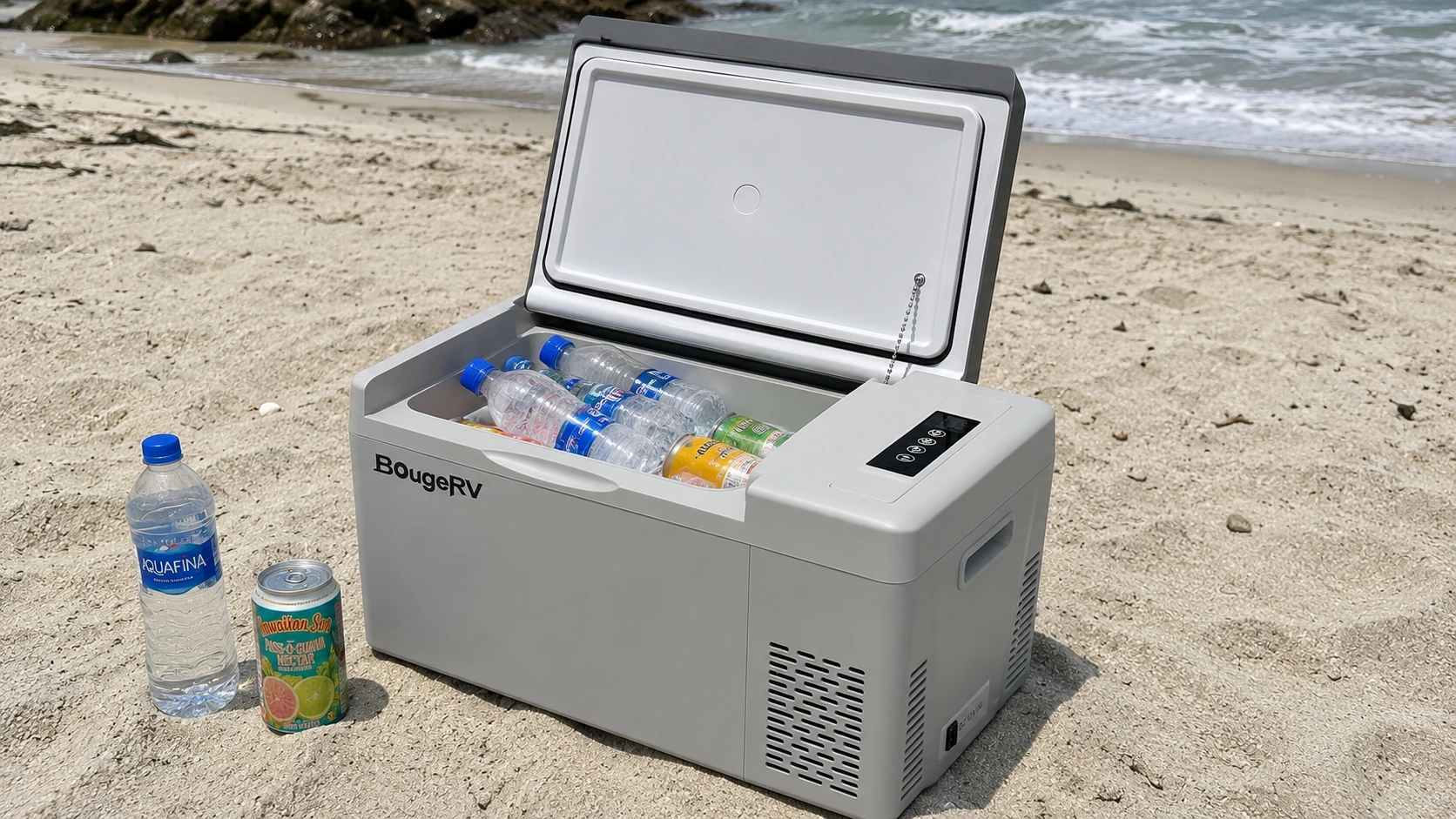
A compact single-zone compressor fridge sized for short trips, smaller cargo areas, and straightforward DC or AC operation.
BrandBougeRV
Cooling
- Capacity
- 23 qt (22 L)
- Cooling type
- Compressor
- Zones
- Single zone
- Temperature range
- -8°F to 50°F
Size and fit
- Exterior dimensions
- 22.7 × 12.6 × 13.0 in
- Weight
- 21.2 lb
- Portability
- Built-in handle
Power and controls
- Power input
- 12/24V DC; 110–240V AC
- Rated power
- 36W ECO / 45W MAX
- Battery protection
- 3-level low-voltage protection
- App control
- No
Best for
- Short road trips and car camping
- Smaller SUVs, crossovers, and limited cargo areas
- Buyers who want a simple single-zone fridge
Not ideal for
- Separate refrigerator and freezer temperatures
- Long family trips that need more storage
Pros
- Compact footprint
- Relatively light for a compressor fridge
- Works from both vehicle DC and household AC power
- Three-level battery protection
Cons
- Single-zone interior
- No app control
- Limited capacity for longer group trips
The CR22 illustrates the central single-zone advantage: nearly all of the available capacity serves one packing job. The compromise is equally clear—changing the setpoint changes the whole interior.
Large single-zone example
The ICECO VL45 expands the same one-zone idea to a 45-liter metal-bodied cabinet. Its open space is better suited to large containers and bulk food than a similarly sized dual-zone fridge whose volume is divided into narrow compartments.
At 27.4 × 15.8 × 19.2 inches, it still demands a sizable cargo area. The benefit is not compactness; it is using a medium-to-large cabinet without a permanent internal split.
Product profile
ICECO VL45 47QT Portable Refrigerator

A metal-bodied single-zone 45-liter fridge with a SECOP compressor, substantial handles, and a layout aimed at overlanding and long-term vehicle use.
BrandICECO
Cooling
- Capacity
- 47.6 qt (45 L)
- Cooling type
- SECOP compressor
- Zones
- Single zone
- Temperature range
- 0°F to 50°F
Size and construction
- Exterior dimensions
- 27.4 × 15.8 × 19.2 in
- Body
- Metal shell
- Handles
- Heavy-duty side handles
- Drain
- Interior drain
Power and controls
- Power input
- 12/24V DC; 110–240V AC
- App control
- No
- Display
- On-unit digital control panel
Best for
- Overlanding and long-term vehicle installations
- Buyers who prefer a metal-bodied fridge
- Medium-to-large single-zone storage
Not ideal for
- Frequent carrying by one person
- Very tight cargo spaces
- Independent refrigerator and freezer temperatures
Pros
- SECOP compressor
- Rugged metal construction
- Large 45-liter single-zone interior
- Strong side handles
Cons
- Heavy and bulky compared with plastic compact models
- No wheels
- Single-zone only
Choose this kind of layout when the entire trip can run at one refrigerator setpoint or when the whole cabinet will be used as a freezer. If you need a small frozen section and a large refrigerated section at the same time, one open compartment cannot provide that separation.
Compact dual-zone example
The ICECO GO20 fits two independently controlled zones into a 21-quart body. A removable partition lets the interior change between a split arrangement and a more open configuration.
This is useful for a narrow use case: one or two travelers who need a small frozen section without moving to a 40- or 50-liter fridge. The tradeoff is compartment size. A total of 20 liters divided in two can become awkward for meal containers, tall bottles, or irregular packages.
Product profile
ICECO GO20 21QT Dual-Zone Portable Refrigerator
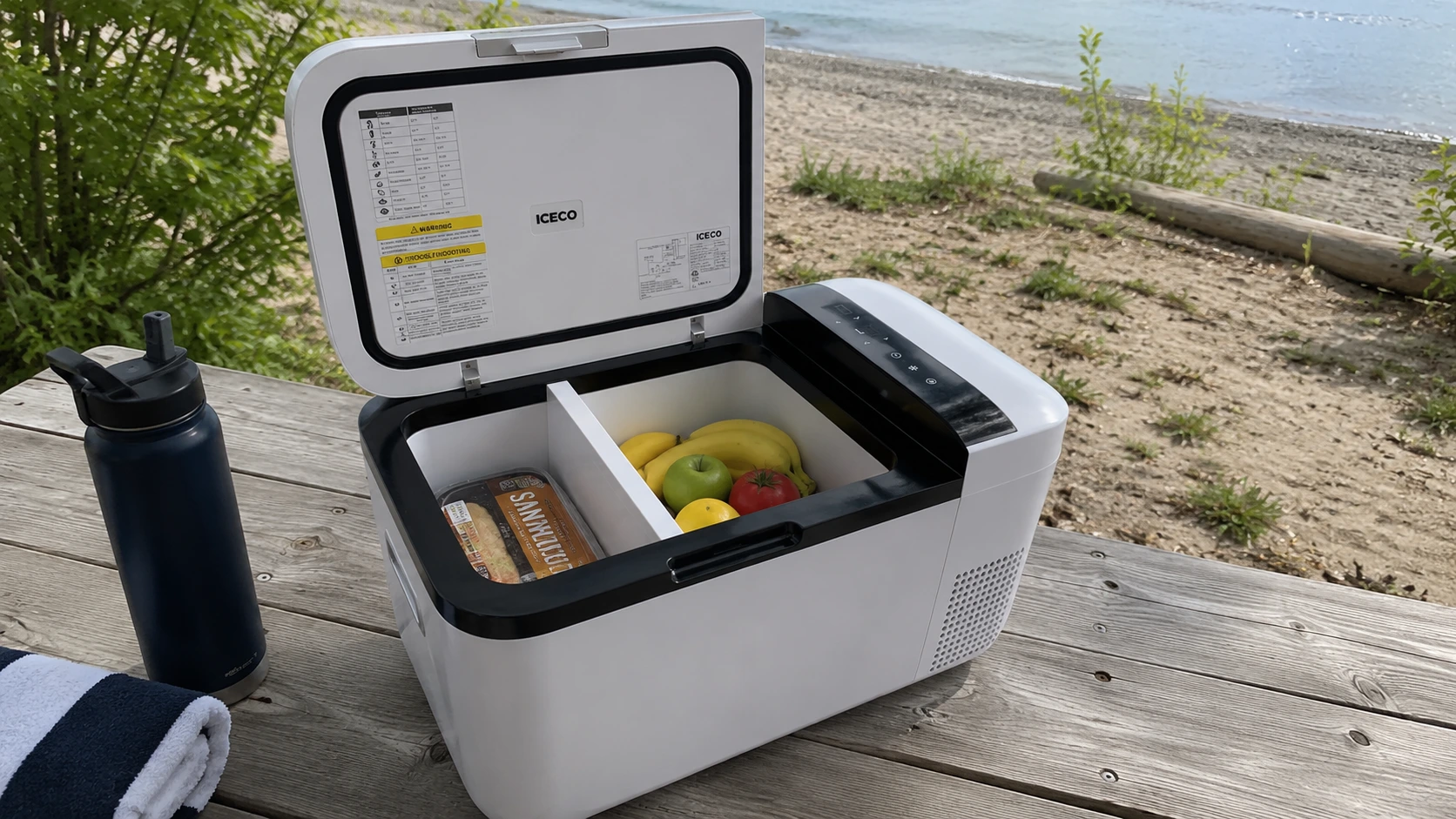
A compact SECOP-compressor fridge that can switch between a single open compartment and two independently controlled zones.
BrandICECO
Cooling
- Capacity
- 21 qt (20 L)
- Cooling type
- SECOP compressor
- Zone configuration
- Two independently controlled zones or one open zone
- Divider
- Removable
- Temperature range
- 0°F to 50°F
Size and fit
- Exterior dimensions
- 22.4 × 12.6 × 12.4 in
- Dual-zone interior
- Left 4.9 × 9.5 × 9.3 in; right 8.0 × 9.5 × 9.3 in
- Single-zone interior
- 13.8 × 9.5 × 9.3 in
Power and controls
- Power input
- 12/24V DC; 110–240V AC
- App control
- Yes
- Temperature controls
- Two digital controllers in dual-zone mode
Best for
- Compact dual-zone use
- Separating frozen and refrigerated items in a small footprint
- Buyers who want a SECOP compressor and app control
Not ideal for
- Large group trips
- Bulky food containers
- Buyers prioritizing the lowest possible cost
Pros
- Flexible single-zone or dual-zone layout
- Independent temperature controls
- Compact footprint
- App control
Cons
- Limited total capacity
- Small individual compartments in dual-zone mode
- No wheels
The GO20 proves that dual-zone does not have to mean large, but it also shows why total liters can mislead. Two controlled spaces are valuable only when the contents fit each side.
Large dual-zone example
The BODEGACOOLER 53QT uses a large 50-liter cabinet with two controlled compartments, wheels, a pull handle, and app control. It is built for a different trip than the GO20: more people, longer gaps between resupply, or a substantial frozen-food load.
Its 28.35 × 14.17 × 18.11-inch body needs careful measurement. The wheels help after unloading, but the fridge still has to pass through the cargo opening and leave room for the lids, power lead, and ventilation.
Product profile
BODEGACOOLER 53QT (50L) Dual-Zone Portable Refrigerator

A large app-controlled dual-zone fridge with wheels, a retractable handle, USB charging, and separate storage for longer vehicle trips.
BrandBODEGACOOLER
Cooling
- Capacity
- 53 qt (50 L)
- Cooling type
- Compressor
- Zones
- Dual zone
- Temperature range
- -4°F to 68°F
Size and handling
- Exterior dimensions
- 28.35 × 14.17 × 18.11 in
- Wheels
- Yes
- Handle
- Retractable pull handle
- Interior light
- Yes
Power and controls
- Power input
- 12/24V DC; 100–240V AC
- Battery protection
- 3-level low-voltage protection
- App control
- Yes
- USB charging port
- Yes
Best for
- Long trips needing a large dual-zone fridge
- Users who want wheels and a pull handle
- App-based temperature control
Not ideal for
- Compact vehicles
- Frequent lifting
- Simple single-zone use
Pros
- Large dual-zone capacity
- Wheels and retractable handle
- App control
- USB charging and interior light
Cons
- Large footprint
- Heavier and harder to install than compact models
- Requires careful measurement for lid and cargo-opening clearance
This style makes sense when both compartments will be used. If the freezer side remains empty most of the trip, a large single-zone fridge can offer simpler packing with fewer partitions.
Which layout gives you more usable space?
For the same advertised total capacity, single-zone usually gives you a more flexible open volume. The entire basket can accept one large pot, wide food container, or mixed stack of drinks and groceries.
Dual-zone capacity is divided. A 50-liter fridge might not offer a 30-liter section plus a 20-liter section in a shape that suits your containers. Compressor housings, baskets, divider thickness, and lid geometry further change the usable space.
Before buying a dual-zone model:
- Find the capacity or dimensions of each compartment, not only the total.
- Measure the largest container you expect to carry.
- Decide how much frozen volume is genuinely necessary.
- Check whether the divider can be removed.
- Use the Portable Fridge Capacity Planner as a starting point, then compare its result with the actual compartment split.
A 45-liter single-zone fridge can be more useful than a 50-liter dual-zone fridge when your menu contains wide containers and no frozen food.
How do exterior size and weight change?
Dual-zone designs are not always heavier than single-zone designs, but the split layout tends to use cabinet space less efficiently. More interior structure is required, and large models often add wheels, separate lids, or additional controls.
Compare these measurements:
- overall width, depth, and height;
- narrowest cargo opening;
- lid-opening height for each compartment;
- empty weight;
- loaded weight based on food and drinks;
- clearance for vents and cable bends;
- space added by a fitted cover or slide.
The Portable Fridge Fit Checker can test both normal and rotated orientation. Rotation is only a dimensional check; it does not guarantee that hinges, vents, controls, or the drain remain accessible.
Does dual-zone cooling change power planning?
A dual-zone label does not produce one predictable watt-hour figure. Power depends on:
- compressor and control design;
- setpoint in each compartment;
- ambient temperature;
- insulation;
- total food load;
- how often each lid opens;
- whether one side is freezing;
- how much surface area separates the zones.
Using one side as a freezer can increase compressor run time compared with running the entire cabinet at a refrigerator temperature. A large dual-zone fridge also has more exterior surface and more food to cool than a compact model.
Do not estimate runtime from total liters alone. Use measured or documented daily energy where available, or enter running watts and a stated duty-cycle assumption in the 12V Fridge Runtime Calculator.
If a model allows one zone to be switched off, confirm how the control system handles that mode. Do not assume the remaining zone uses exactly half the energy.
Which layout is easier to pack?
Single-zone is easier when:
- the contents share one temperature;
- meal containers are large;
- tall bottles need flexible placement;
- you frequently change the mix of food and drinks;
- you want to use baskets without a fixed divider.
Dual-zone is easier when:
- frozen and refrigerated items must stay separate;
- raw meat needs a dedicated compartment;
- drinks are opened frequently while food stays closed in the other zone;
- two travelers or groups need clearly separated storage;
- each compartment’s shape matches the planned contents.
The second list is about organization as much as temperature. Two lids can reduce the amount of warm air entering the food side when only a drink is needed, but the practical benefit depends on the exact design and how the fridge is used.
Which trips genuinely benefit from two zones?
Dual-zone earns its space on trips such as:
- multi-day remote camping with frozen meals;
- fishing or hunting trips where one side is reserved for a different temperature job;
- family travel with refrigerated food and frozen treats;
- van or RV use where the portable fridge supplements another refrigerator;
- trips where one compartment is opened frequently and the other should stay closed.
A weekend of drinks, sandwich ingredients, and breakfast food rarely needs two temperatures. In that situation, spend the capacity on one open compartment and use the battery budget for longer runtime.
The Best Dual-Zone Portable Fridge Freezers guide compares models only after the two-temperature need has been established.
When is dual-zone not worth the tradeoff?
Skip dual-zone when:
- everything can be stored at one safe refrigerator temperature;
- frozen food is not part of the menu;
- cargo space is tight;
- one compartment would be too narrow for your containers;
- the fridge must be lifted frequently;
- power capacity is limited and freezer use would raise the load;
- you prefer simple local controls;
- the divider cannot be removed and would often waste space.
The feature is not harmful; it is simply expensive in space and complexity when unused. A good single-zone fridge is not a lesser product. It is a different packing tool.
FAQ
Can a dual-zone fridge run both compartments as refrigerators?
Many models allow both sides to be set within refrigerator temperatures, but the exact control rules are model-specific. Read the manual rather than assuming every combination is supported.
Can a dual-zone fridge become single-zone?
Some models use a removable divider and can operate as a larger open compartment. Others retain a fixed wall or separate lids. The product description should state the layout explicitly.
Is a divided fridge always dual-zone?
No. Two physical storage sections under one thermostat are still a single-control design. True dual-zone requires independent temperature control.
Does dual-zone use twice as much power?
Not automatically. Energy depends on total cabinet size, setpoints, ambient conditions, insulation, food load, and compressor behavior. Freezer use can increase demand, but there is no universal two-times multiplier.
Is single-zone better for drinks?
It is often easier to pack because cans and bottles can fill one open space. Dual-zone can be useful when drinks are separated from food or opened frequently.
What size dual-zone fridge should two people buy?
Start with the food and drink volume between resupply stops, then check the capacity split. A compact 20-liter dual-zone fridge can have very small individual compartments, while a 40- to 50-liter model requires much more vehicle space.
Can I use one dual-zone compartment as dry storage?
You can leave a compartment unpowered or warmer only if the product supports that mode. Dry storage also needs to remain suitable for the items inside; follow the product instructions.