


Quick answer
The simplest camping setup is usually a fridge connected directly to a portable power station’s regulated 12V output, with enough usable watt-hours for the parked period and a separate plan for recharging. A vehicle outlet can handle the driving portion when its current rating and ignition behavior are known. Relying on the starter battery overnight is the option that needs the most caution.
A portable fridge is a modest load compared with a kettle or space heater, but it is persistent. The compressor may cycle for minutes at a time, rest, then restart throughout the night. That pattern turns a small wattage number into a meaningful daily energy demand.
The useful question is not only, “Can this outlet turn the fridge on?” It is also:
- How many watt-hours will the fridge use before the next recharge?
- Will the source remain on after the ignition is switched off?
- Can the cable and connector carry the load without excessive voltage drop?
- Will low-voltage protection stop the fridge before the food warms?
- Is the battery intended for repeated cycling, or mainly for starting an engine?
This guide stays at the planning and equipment-selection level. Permanent vehicle wiring, battery isolation, fuse placement, and cable sizing should follow the vehicle, battery, and equipment documentation or be handled by a qualified installer.
How much energy does a 12V fridge use over a day?
Running watts are only one part of the answer. A compressor fridge might draw 40 to 60 watts while the compressor is active, then draw much less when it is resting. Daily energy depends on how often it runs.
The most useful input is watt-hours per day measured under conditions close to your trip. When that figure is unavailable, estimate average load from running watts and duty cycle:
Average load = running watts × duty cycle
Daily energy = average load × 24 hours
A 45-watt compressor operating 40 percent of the time averages 18 watts:
45 W × 0.40 = 18 W average
18 W × 24 h = 432 Wh/day
That is a planning example, not a universal fridge result. Hot ambient air, a freezer setpoint, poor ventilation, warm groceries, frequent lid openings, and battery voltage can all change the duty cycle.
Do not use a product’s maximum wattage as if the fridge draws that amount continuously. Doing so can overstate energy use by a large margin. The opposite mistake—assuming an unrealistically low duty cycle—can leave the battery undersized.
How should you use the Runtime Calculator?
The 12V Fridge Runtime Calculator supports two methods:
- Enter measured or documented watt-hours per day.
- Enter running watts and a transparent duty-cycle estimate.
Then add:
- the battery’s rated watt-hours, or amp-hours and nominal voltage;
- usable-capacity percentage;
- the reserve you want to keep;
- direct-DC or AC-inverter operation;
- conversion efficiency;
- inverter idle draw when applicable;
- an uncertainty range.
The calculator returns a conservative-to-optimistic range rather than one falsely precise number. It does not apply a hidden hot-weather or freezer multiplier. When conditions are likely to be harder than the source data, use the visible manual adjustment in Advanced mode.
For a first pass, calculate only the parked period. If the fridge runs from the vehicle while driving and from a power station at camp, the power station does not need to cover the hours when the alternator-supported outlet is doing the work.
Can you use a vehicle 12V outlet while driving?
Often, yes—provided the outlet rating, fridge plug, and vehicle instructions agree.
Before using the outlet, find three facts:
- its maximum current or power rating;
- whether it remains energized with the ignition off;
- whether the vehicle limits or switches the outlet under certain conditions.
A 12V accessory outlet marked 10A has a nominal 120-watt ceiling at 12 volts, but the usable margin depends on the vehicle, connector condition, voltage, and other loads on the circuit. The fridge’s startup behavior must also remain within the source and cable limits.
Do not replace a fuse with a higher value to keep a fridge running. The fuse protects the circuit it was designed for. A recurring blown fuse, hot plug, softened socket, intermittent display, or low-voltage error is a reason to stop and investigate—not a reason to increase the fuse size.
Some outlets shut off as soon as the engine stops. Others remain live indefinitely. A third group stays active for a timed period. Test the behavior before the trip or consult the owner’s manual; do not infer it from the fact that the dashboard has gone dark.
Why is a starter battery risky for long parked use?
A starter battery is built around short bursts of high current and normally remains at a high state of charge. The U.S. Department of Energy describes starting-lighting-ignition use as brief, shallow discharge rather than repeated deep cycling.
A fridge is the opposite kind of load: smaller, but sustained for hours. If the outlet remains live, the fridge can consume enough energy to leave the engine unable to start even though the fridge’s low-voltage protection has not yet tripped.
Three thresholds may be different:
- the fridge’s low-voltage cutoff;
- the voltage at which the battery is already too depleted for reliable starting;
- the voltage seen at the fridge after cable and socket loss.
That is why low-voltage protection is useful but not a promise that the vehicle will start afterward. The exact setting also varies by product. If you are seeing shutdowns or weak starts, work through 12V Fridge Draining Your Car Battery rather than lowering the cutoff automatically.
For regular overnight use, a dedicated portable power station or properly designed auxiliary battery system is easier to plan than an unknown reserve in the starter battery.
How does direct DC from a portable power station work?
A portable power station with a regulated 12V output can provide a clean separation between fridge runtime and the starter battery. The fridge plugs into the station’s DC socket, and the station is recharged from AC, a vehicle charging source, solar, or another supported input.
Direct DC usually avoids the extra conversion path of:
Battery DC → inverter AC → fridge AC adapter → fridge DC electronicsThe direct route is closer to:
Battery DC → regulated 12V output → fridgeThat does not guarantee every DC port is suitable. Confirm:
- the port’s continuous current rating;
- the connector type;
- whether the output is regulated near 12V;
- whether the port has an automatic shutoff or power-saving mode;
- whether the fridge’s startup current is supported;
- the total output limit shared with other DC devices.
If a station turns off because the average load is low, disable the station’s energy-saving feature when the manual allows it. Do not assume that a high total inverter wattage means the 12V socket has the same capability; ports often have separate limits.
When does an AC inverter make sense?
AC operation is useful when:
- the fridge has a reliable household adapter but no compatible DC lead;
- campsite shore power is available;
- the AC outlet is more convenient than the available DC port;
- the equipment documentation specifically directs you to the AC adapter.
The tradeoff is conversion loss. A battery power station must create AC, and the fridge adapter converts that AC back to the voltage the fridge uses. The inverter may also consume power just by remaining on.
On a large appliance, a few idle watts may be minor. On a fridge averaging 15 to 25 watts over a day, a 5-watt inverter idle load can materially reduce runtime.
Use AC when it solves a real compatibility problem, not because the power station’s AC socket looks more familiar. Compare both paths in the runtime calculator with the appropriate efficiency and idle-draw assumptions.
How does an auxiliary battery setup differ?
An auxiliary battery is a separate energy store intended to run camping loads without depending directly on the starter battery. Depending on the vehicle and system, it may be charged by a DC-to-DC charger, shore power, solar, or a combination.
The planning benefits are clear:
- fridge consumption is separated from engine-starting reserve;
- usable capacity can be chosen for the expected load;
- the outlet can be located near the fridge;
- the charging path can be designed around the battery chemistry and alternator system.
The installation work is not trivial. Battery chemistry, cable protection, conductor size, fuse placement, grounding, isolation, ventilation, mounting, and charging voltage all matter. Modern vehicles may also use smart alternators and battery-management systems.
This article does not provide a universal wiring diagram because there is no universal vehicle or battery installation. Use the equipment instructions and professional help where the system connects permanently to the vehicle electrical architecture.
Why do cable length, connector quality, and voltage drop matter?
The fridge does not see battery voltage; it sees the voltage that arrives after the outlet, plug, cable, and every connection in between.
Longer or smaller conductors create more voltage drop at the same current. Loose accessory plugs and worn sockets add resistance. A cable may carry enough power to light the display but still let voltage sag when the compressor starts.
Symptoms can include:
- intermittent compressor starts;
- low-voltage error codes;
- cycling between on and off;
- a warm plug or socket;
- normal operation on AC but not on vehicle DC;
- shutdowns that happen sooner than the battery’s state of charge suggests.
Extra length is not automatically bad, but it must be treated as part of the circuit. Use the shortest practical route, keep connections clean and fully seated, and stay within the current rating of the source outlet and extension cable.
A locking DC connector can be more secure than a cigarette-lighter-style plug on rough roads, but compatibility depends on the fridge. Do not splice a proprietary lead simply to adopt a preferred connector without the manufacturer’s guidance.
Useful power accessories
The products below solve three different connection problems. They are not interchangeable, and none of them increases the capability of the source circuit.
As an Amazon Associate I earn from qualifying purchases.
- Best for adding temporary 12V reachNOCO GC019 12V Plug 12-Foot Extension CableJump to pick
- Best for sharing one compatible 12V outletNOCO GC020 12V Plug 2-Way SplitterJump to pick
- Best for running a compatible fridge from household ACAstroAI 15A 180W AC-to-DC ConverterJump to pick
- Best for a compatible auxiliary-battery socketNOCO GC018 12V Socket Adapter with Eyelet TerminalsJump to pick
| Option | Role | Connection | Published limit | Installation style |
|---|---|---|---|---|
| NOCO GC019 | Add temporary 12V reach | Male 12V plug to female 12V socket | 15 A; 20 A fuse | Plug-in extension |
| NOCO GC020 | Split one compatible 12V outlet into two sockets | One male 12V plug to two female 12V sockets | 15 A shared total | Plug-in splitter |
| AstroAI 15A converter | Create a 12V socket from household AC | 100–240V AC to 12V female socket | 15 A / 180 W | Portable AC-powered converter |
| NOCO GC018 | Add a socket to a compatible battery | M10 eyelets to female 12V socket | 15 A; 20 A fuse | Fixed battery-terminal connection |
Best for adding temporary 12V reach
The NOCO GC019 adds 12 feet between a male 12V plug and a female accessory socket. NOCO lists a 15-amp rating, 16 AWG copper conductors, an inline 20-amp mini-blade fuse, an LED power indicator, and a water-resistant cap on the female socket.
That makes it useful when the vehicle outlet is near the dashboard and the fridge is secured farther back. It does not turn a marginal outlet into a stronger one. The longer path adds resistance, so monitor the plug and fridge behavior under compressor load.
Product profile
NOCO GC019 12V Plug 12-Foot Extension Cable
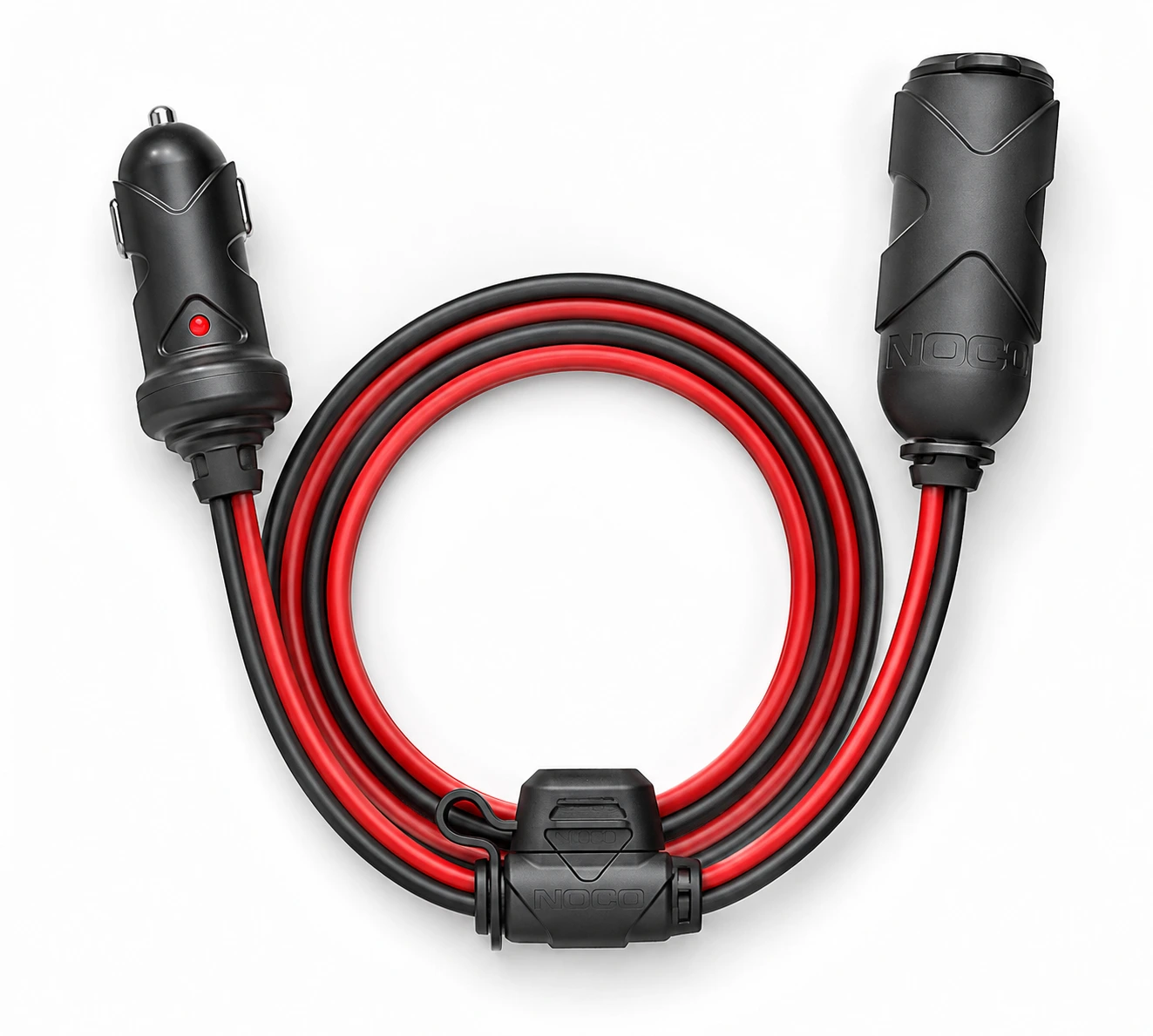
A fused 12-foot male-to-female 12V extension cable for adding reach between a vehicle or battery-powered accessory socket and a compatible portable fridge.
BrandNOCO
Connection
- Model
- GC019
- Input
- 12V male accessory plug
- Output
- 12V female accessory socket
- Cable length
- 12 ft (3.7 m)
Electrical
- Rated current
- 15 A
- Wire gauge
- 16 AWG
- Fuse
- 20 A mini-blade fuse
- Conductor
- Copper
Construction
- Socket protection
- Water-resistant cap
- Power indicator
- LED
- Connection style
- Male-to-female plug and socket
Best for
- Extending a 12V outlet to a portable fridge in a larger vehicle or campsite
- Temporary installations where a direct hardwired connection is not needed
- 12V devices that stay within the cable and outlet current limits
Not ideal for
- Loads above the 15 A cable rating
- Permanent hardwired installations
- Setups where a locking connector is required
Pros
- Adds 12 feet of reach
- Integrated fuse protection
- Water-resistant cap on the female socket
- LED shows when the socket is powered
Cons
- Extra cable length can increase voltage drop
- Uses a non-locking accessory plug and socket
- The vehicle or source outlet must still support the connected load
Choose it when you need temporary reach and the source outlet already supports the fridge. Skip it when the circuit is failing because of low source voltage, poor socket contact, or an inadequate current rating.
Best for sharing one compatible 12V outlet
The NOCO GC020 turns one vehicle-style accessory plug into two female 12V sockets. Its published 15-amp rating is shared across both outputs; the splitter does not provide 15 amps to each socket and does not increase the vehicle outlet or fuse capacity.
That makes it useful only when the fridge and second accessory remain within the lowest applicable limit in the full circuit. Two high-draw devices can overload the source even when each works correctly by itself. The extra connector also needs to stay fully seated and away from moisture or moving cargo.
Product profile
NOCO GC020 12V Plug 2-Way Splitter
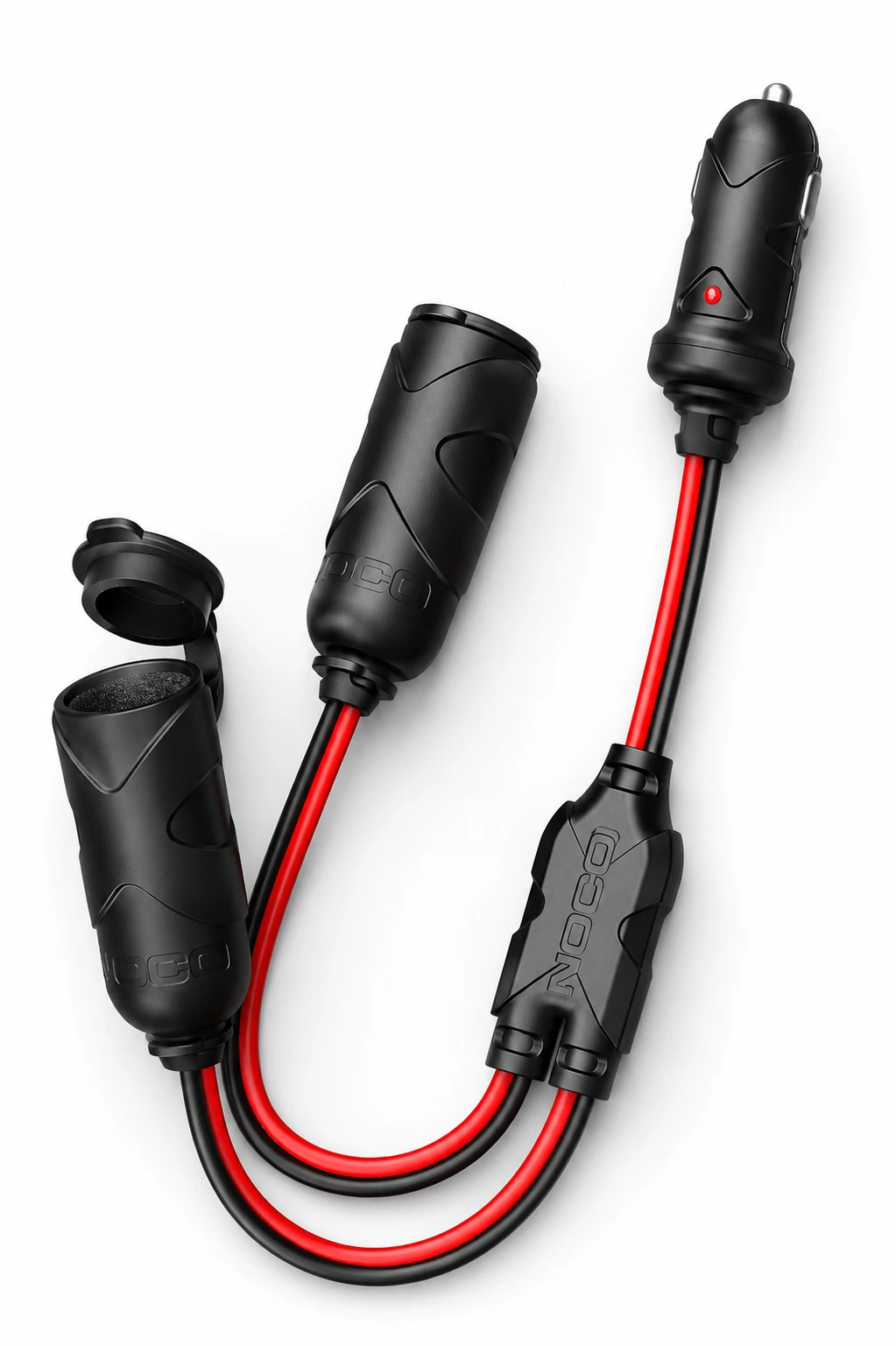
A fused 12V splitter that turns one vehicle-style accessory outlet into two sockets while keeping the total connected load within a 15-amp rating.
BrandNOCO
Connections
- Input
- One 12V male accessory plug
- Outputs
- Two 12V female accessory sockets
- Use
- Runs two compatible 12V accessories from one outlet
Electrical
- Total current rating
- 15A shared across both outputsThe splitter does not increase the rating of the vehicle outlet, wiring, or fuse.
- Wire size
- 16 AWG copper
- Fuse
- Integrated 20A micro-blade fuse
Construction
- Cable spacing
- 6.3 in from input to outputs; up to 10.6 in between output ports
- Socket protection
- Water-resistant cap
- Environmental resistance
- Designed to resist dirt, water, oil, and gasoline exposure
Best for
- Running a portable fridge alongside a low-draw 12V accessory
- Separating two accessory plugs in a vehicle or campsite setup
- Users who need a fused, branded splitter rather than an unmarked adapter
Not ideal for
- Powering two high-draw devices at the same time
- Exceeding the vehicle outlet or fuse rating
- Permanent hardwired installations
Pros
- Two 12V outputs
- 15A-rated 16 AWG construction
- Integrated fuse
- Water-resistant cap
- Flexible spacing between sockets
Cons
- 15A is shared rather than available to each outlet
- Does not solve an undersized or switched vehicle outlet
- Adds another connection point that should be kept secure
Choose it for a compatible fridge plus a genuinely low-draw second accessory. Do not use it to work around a weak outlet, a blown fuse, or insufficient vehicle wiring.
Best for running a compatible fridge from household AC
The AstroAI converter accepts household AC and provides a 12V female accessory socket. Its published ceiling is 15 amps and 180 watts, leaving enough nominal headroom for many portable fridges whose operating and startup demand remain within those limits.
The important phrase is within those limits. Confirm the fridge’s adapter requirements, connector, startup behavior, and the converter’s placement. The built-in fan needs airflow, and the unit is not a reason to use indoor equipment in wet conditions.
Product profile
AstroAI 15A 180W AC-to-DC Converter

A household-AC to 12V DC converter with a cigarette-lighter-style output socket for running compatible portable fridges and other 12V devices within its 15A and 180W output limits.
BrandAstroAI
Power conversion
- Input
- 100–240V AC, 50–60 Hz
- Output
- 12V DC
- Maximum output
- 15 A / 180 W
- Output socket
- 12V female accessory socket
Physical details
- Cable length
- 8.25 ft
- Converter dimensions
- 6.3 × 3.38 × 2.18 in
- Cooling
- Built-in fan
- Wire construction
- Copper conductors
Best for
- Running a compatible 12V fridge from household AC power
- Garage, home, or campsite hookups where a 12V socket output is convenient
- Devices whose operating and startup requirements remain within 15 A and 180 W
Not ideal for
- Devices that require more than 180 W or 15 A
- Wet or exposed outdoor locations
- Fridges that use a proprietary connector instead of a 12V accessory plug
Pros
- Full 15 A / 180 W output rating
- Accepts a broad 100–240V AC input range
- Long combined cable reach
- Built-in cooling fan
Cons
- Adds conversion loss compared with direct DC operation
- The converter and fan add bulk to the setup
- Fridge startup demand and plug compatibility must be checked separately
This is most useful at home, in a garage, or at a campsite with shore power when you want a 12V socket output. If the fridge’s own AC adapter is available and specified for the model, that may be the simpler path.
Best for a compatible auxiliary-battery socket
The NOCO GC018 connects to compatible battery terminals through M10 / 3/8-inch eyelets and provides a female 12V socket. NOCO publishes a 15-amp rating, 16 AWG copper conductors, a 20-amp fuse, and a water-resistant socket cap.
This is a short fixed lead, not a complete auxiliary-battery system. It does not handle charging, isolation, battery mounting, conductor protection elsewhere in the system, or compatibility with the vehicle.
Product profile
NOCO GC018 12V Socket Adapter with Eyelet Terminals
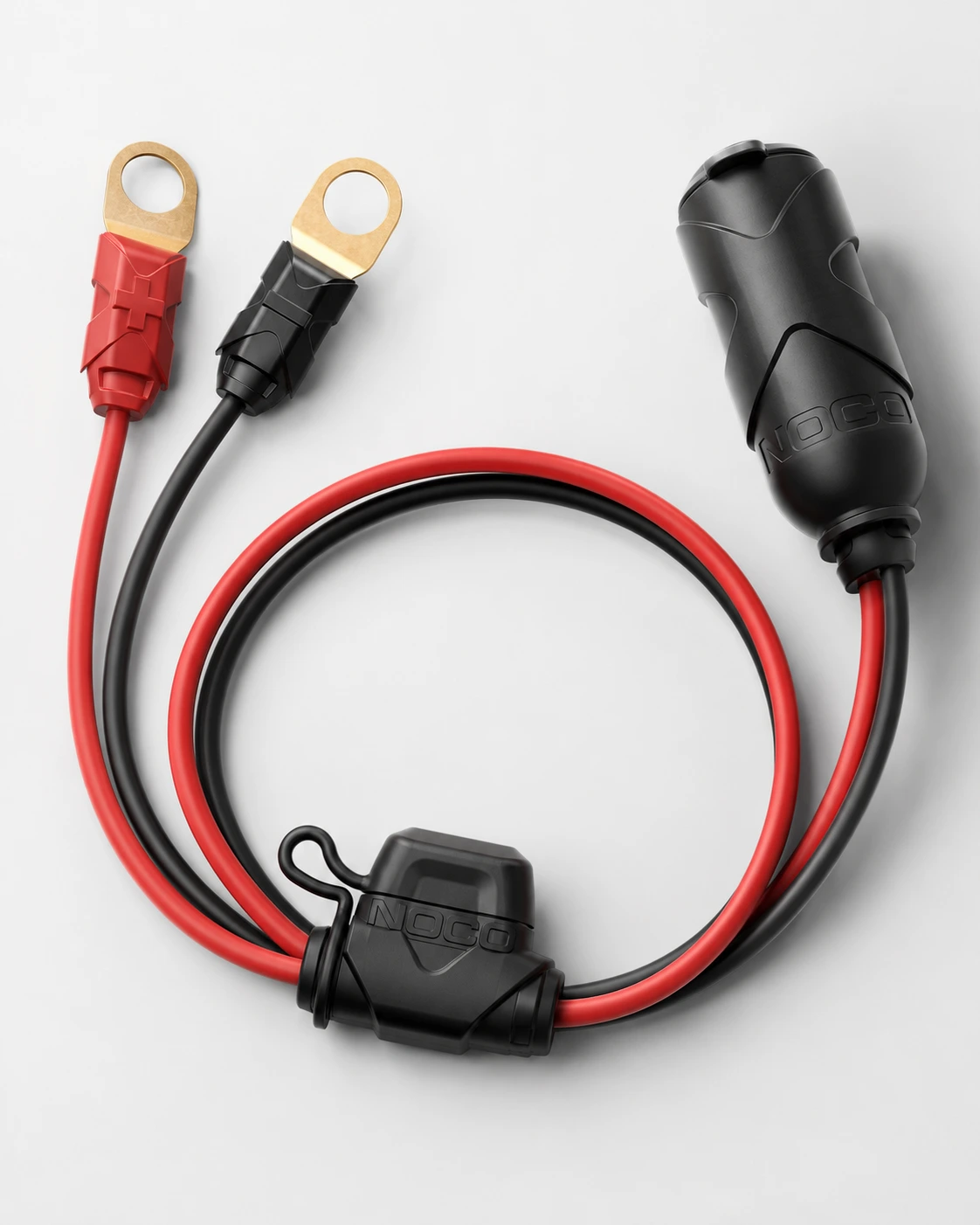
A fused eyelet-to-12V-socket adapter for creating an auxiliary accessory outlet from a compatible 12V battery terminal connection.
BrandNOCO
Connection
- Model
- GC018
- Battery connection
- M10 / 3/8-in eyelet terminals
- Output
- 12V female accessory socket
- Length
- 24 in cable; 28 in overall
Electrical
- Rated current
- 15 A
- Wire gauge
- 16 AWG
- Fuse
- 20 A mini-blade fuse
- System voltage
- 12V
Construction
- Socket protection
- Water-resistant cap
- Installation style
- Fixed eyelet-terminal connection
Best for
- Adding a fused 12V socket to a compatible auxiliary battery
- Portable-fridge setups that need a short fixed battery connection
- Users who can verify terminal size, polarity, fuse placement, and load limits
Not ideal for
- Temporary clamp-on connections
- Battery terminals that do not accept M10 / 3/8-in eyelets
- Loads above the 15 A rating
Pros
- Creates a dedicated 12V female socket
- Integrated fuse protection
- Compact cable length
- Water-resistant socket cap
Cons
- Requires a direct battery-terminal installation
- Not a quick removable clamp connection
- Terminal compatibility and safe routing must be checked before use
Use it only when the battery terminals, polarity, load, fuse, and cable routing have been checked as part of a safe system. It is not the right accessory for someone looking for a no-tools temporary connection.
Where does solar charging fit into the plan?
Solar does not run the fridge in isolation; it replenishes a battery or power station while the fridge continues to consume energy.
A useful daily-energy comparison is:
Daily solar energy delivered to the battery
versus
Daily fridge energy plus other loads
Panel wattage is not daily energy. Weather, shade, sun angle, temperature, charge-controller efficiency, and the battery’s ability to accept charge determine the real watt-hours delivered.
A 200-watt panel does not produce 200 watts from sunrise to sunset. At the same time, a system does not need to replace the entire fridge load every day when the battery has enough reserve for cloudy periods and another charging source is available.
Plan solar after you understand the fridge load. Otherwise, panel selection becomes guesswork built on another guess.
Common power-planning mistakes
- Treating running watts as daily energy. Compressor duty cycle determines the average load.
- Assuming the starter battery is spare capacity. Starting batteries are designed around engine starts, not routine deep cycling.
- Using AC because the inverter has a large headline wattage. The 12V fridge may run longer through a suitable direct-DC path.
- Ignoring inverter idle draw. A few watts matter when the fridge’s average load is modest.
- Extending a weak circuit. A longer cable cannot repair an undersized or worn source outlet.
- Lowering low-voltage protection before diagnosing the circuit. The cutoff may be responding to real battery depletion or voltage drop.
- Counting solar panel watts as guaranteed energy. Daily output changes with conditions.
- Forgetting the warm-start load. Cooling newly purchased food takes more energy than maintaining an already cold load.
- Planning runtime without a recharge schedule. Capacity only answers how long the battery lasts once; the trip needs a repeatable energy plan.
FAQ
Can I plug a 12V fridge directly into a car outlet?
Yes, when the fridge plug, outlet rating, fuse, and vehicle instructions are compatible. Confirm whether the outlet remains powered after the ignition is switched off and do not exceed the circuit rating.
Is it better to run a portable fridge on DC or AC?
Direct DC is often more efficient because it avoids inverter conversion, but the correct choice depends on the available ports and the fridge documentation. AC can be practical at home or on shore power.
How large a power station do I need?
Estimate the fridge’s watt-hours per day, decide how long it must run before recharging, then account for usable capacity, reserve, and connection losses. The runtime calculator turns those inputs into a planning range.
Can I run a fridge from a starter battery overnight?
It can consume enough energy to prevent the engine from starting. Low-voltage protection reduces risk but does not guarantee starting reserve. A separate power source is easier to plan for overnight use.
Does a longer 12V cable reduce performance?
It can. Longer cable length and resistive connections increase voltage drop. The effect depends on conductor size, current, connector condition, and source voltage.
Will a 180-watt converter run any portable fridge?
No. The fridge’s operating demand, startup behavior, connector, and adapter requirements must remain within the converter’s 15-amp and 180-watt limits.
Can solar keep a 12V fridge running indefinitely?
Only when the charging system consistently replaces the fridge and other loads while preserving enough battery reserve for weak-sun periods. Panel wattage alone cannot establish that.
What should I do if the fridge keeps showing a low-voltage error?
Test the source battery, outlet, plug, and cable under load before changing the cutoff setting. The not-cooling guide covers voltage-related symptoms, while the battery-drain guide focuses on the vehicle battery.