
Quick verdict
Choose a chest fridge when portability, open packing space, and easy removal matter. Choose a drawer fridge when the appliance will be mounted beneath a bunk, shelf, counter, or sleeper-cab cabinet and the front of the installation can remain clear.
Chest and drawer refrigerators can use the same compressor technology while behaving very differently in a vehicle. A chest opens upward and can be removed like a cooler. A drawer opens forward and behaves more like built-in cabinetry.
The drawer’s low height is attractive, but its depth and required front travel are easy to overlook. The chest’s footprint may fit, but the lid can collide with a cargo cover or platform. The decision should be made from the full access envelope rather than closed dimensions alone.
This comparison uses the BODEGAcooler 33QT drawer as the drawer example and several chest fridges at different sizes. The purpose is not to crown one form factor; it is to show where each layout helps and where it creates a new constraint.
Chest vs drawer at a glance
| Option | Access direction | Best installation | Main clearance need | Portability | Packing behavior | Main drawback |
|---|---|---|---|---|---|---|
| Chest-style fridge | Lid opens upward | Cargo area, slide, temporary or removable setup | Open-lid height above cabinet | Usually designed to be carried or moved | Deep open volume; items can stack vertically | Top access can be blocked by shelves or cargo |
| Drawer-style fridge | Drawer pulls forward | Sleeper cab, van cabinet, RV counter, built-in bay | Full drawer travel in front | Usually semi-permanent or permanent | Shallow front-access tray; tall items may be limited | Requires mounting, ventilation, and clear front space |
How do real products compare?
The drawer example is lower than every chest model in the table, but it is also deeper and heavier than several compact chests. That is why “low profile” should not be confused with “small.”
| Option | Capacity | Installation type | Exterior dimensions | Weight | Zone layout | App control |
|---|---|---|---|---|---|---|
| BODEGAcooler 33QT 12V Drawer Refrigerator | 33 qt (31 L) | Built-in drawer | 28.8 × 17.3 × 9.8 in | 43 lb | Single zone | Yes |
| Dometic CFX2 37L Portable Refrigerator and Freezer | 37 L (about 39 qt) | Not listed | 26.7 × 15.8 × 16.9 in | 34.8 lb | Single zone | Yes |
| ICECO APL35 37QT Dual-Zone Portable Refrigerator | 37 qt (35 L) | Not listed | 27.0 × 14.4 × 15.7 in | 32 lb | Dual zone | Yes |
| BougeRV CR22 23QT Portable Refrigerator | 23 qt (22 L) | Not listed | 22.7 × 12.6 × 13.0 in | 21.2 lb | Single zone | No |
| ICECO VL45 47QT Portable Refrigerator | 47.6 qt (45 L) | Not listed | 27.4 × 15.8 × 19.2 in | Not listed | Single zone | No |
What is a chest-style 12V fridge?
A chest fridge resembles a powered cooler. The lid opens upward, the compressor occupies part of the cabinet, and the interior is loaded from the top.
The form has several advantages:
- cold air tends to remain in the cabinet when the lid opens;
- deep storage can accept tall or irregular containers;
- baskets can often be removed for loading and cleaning;
- the fridge can be carried out of the vehicle;
- many sizes and zone layouts are available;
- the same fridge can move between a car, RV, home, and campsite.
The main problem is vertical access. A chest beneath a bed platform may fit closed and be unusable open. Some installations solve that with a slide, removable lid, or side-opening design, but each adds measurement and restraint questions.
What is a drawer-style 12V fridge?
A drawer fridge uses front access. The cabinet is mounted in a bay and the refrigerated compartment slides out on rails.
This layout works beneath:
- truck sleeper bunks;
- van counters;
- RV cabinets;
- cargo shelves;
- work-vehicle storage systems.
The drawer can be opened without lifting a lid, which preserves vertical space. The front of the cabinet must remain clear for the full extension, and the installation must resist the leverage created by an open loaded drawer.
A drawer is usually not a portable appliance in daily use. It may be technically removable, but mounting hardware, wiring, and weight make it part of the vehicle layout.
Which fits beneath a shelf or bed platform?
A drawer usually wins when height is the strict constraint. The BODEGAcooler 33QT is about 9.8 inches tall, while the chest examples range from roughly 13 to 19 inches before lid clearance.
The drawer’s advantage can disappear when depth is limited. At about 28.8 inches deep, it needs a long bay and clear space behind for wiring and ventilation. It also needs a similar distance in front for the drawer to open.
A chest can be shorter than expected if a compact model is selected, but the lid may need another 12–20 inches above the closed cabinet. Measure the open position rather than guessing from hinge angle.
Use the Fit Checker for the closed cabinet, then add the actual lid or drawer travel from the product documentation.
Which is easier to access every day?
A drawer presents food at waist or knee height and can keep frequently used items visible. It is particularly convenient in a truck sleeper or van galley where the fridge is part of the furniture.
A chest can require bending and moving top items to reach the bottom. It may also be placed on a slide so the whole cabinet pulls into the aisle or hatch opening.
Access depends on organization. A shallow drawer can make tall bottles impossible. A deep chest can hide small items beneath large containers. Baskets and labeled bins improve either layout.
The better form is the one that lets you reach common food without moving bedding, seats, or other cargo.
Which packs more efficiently?
Chest fridges usually offer more flexible vertical space. Large containers can use the full depth, and an open single-zone cabinet can accept irregular shapes.
Drawer fridges have a shallow interior. Food is spread across a larger floor area, which improves visibility but limits tall packages. The drawer rails and front structure also consume some volume.
For a truck driver storing meal-prep containers, the drawer can be excellent. For a camper carrying tall bottles, vegetables, and mixed food bags, the chest may pack more naturally.
Capacity labels do not reveal that difference. Compare internal dimensions and the actual containers.
Which is easier to remove from the vehicle?
A chest is designed for removal. Unplug it, release the straps, empty or reduce the load, and carry it by the handles.
A drawer requires disconnecting wiring and removing mounting hardware or brackets. The BODEGAcooler example weighs 43 pounds before food. It is better treated as installed equipment.
Choose a chest when:
- the vehicle changes frequently;
- the fridge comes inside between trips;
- the campsite uses the fridge away from the vehicle;
- permanent mounting is not allowed;
- one product must serve several vehicles.
Choose a drawer when the installation will remain in one truck, van, or RV.
Which is easier to secure?
Neither is automatically safer.
A chest needs straps, tie-down points, or a rated slide that controls movement in all directions. The restraint should not block vents or damage the lid.
A drawer needs a mounting frame attached to a suitable structure, a positive latch, and hardware that supports both the cabinet and the leverage of the open loaded drawer. Screwing the fridge into decorative cabinetry without understanding the structure is not enough.
The guide How to Secure a Portable Fridge in a Vehicle covers loaded weight, anchors, and cable strain relief.
Which ventilates more easily?
A chest in an open cargo area often has more air around it. Problems arise when it is packed tightly between bags or placed inside a drawer system without vent openings.
A drawer fridge is built into a bay, so ventilation must be designed into the enclosure. The rear and side clearances in the exact manual matter. Hot air should not be trapped behind the cabinet.
App control can hide an overheating installation because the user does not inspect the physical area often. Remote control is convenient, but the vent and cable still need regular access.
Which is better for truck drivers?
A drawer can be the better daily appliance when it fits beneath a sleeper cabinet and the truck assignment is stable. It keeps the aisle clear and can be opened without moving the bunk.
A compact chest is better when the driver changes trucks, brings the fridge home, or cannot mount permanent equipment. The Best Portable Fridges for Truck Drivers guide compares both approaches.
Which is better for overlanding?
A chest offers more model choice, including large dual-zone, battery-powered, and rugged metal cabinets. It is also easier to replace after a failure.
A drawer works well in a purpose-built van or pickup system where front access is valuable. It should not be chosen merely because the flat top can support cargo; the cabinet and installation still need ventilation and service access.
Drawer example: BODEGAcooler 33QT
The BODEGAcooler 33QT is a 31-liter single-zone drawer about 28.8 × 17.3 × 9.8 inches. Its low height is the central advantage. App control helps when the physical controls are inside a cabinet.
The fridge weighs 43 pounds and needs a built-in installation. Its drawer travel requires open space in front, and the 28.8-inch depth can be restrictive in a shallow sleeper or van module.
Product profile
BODEGAcooler 33QT 12V Drawer Refrigerator
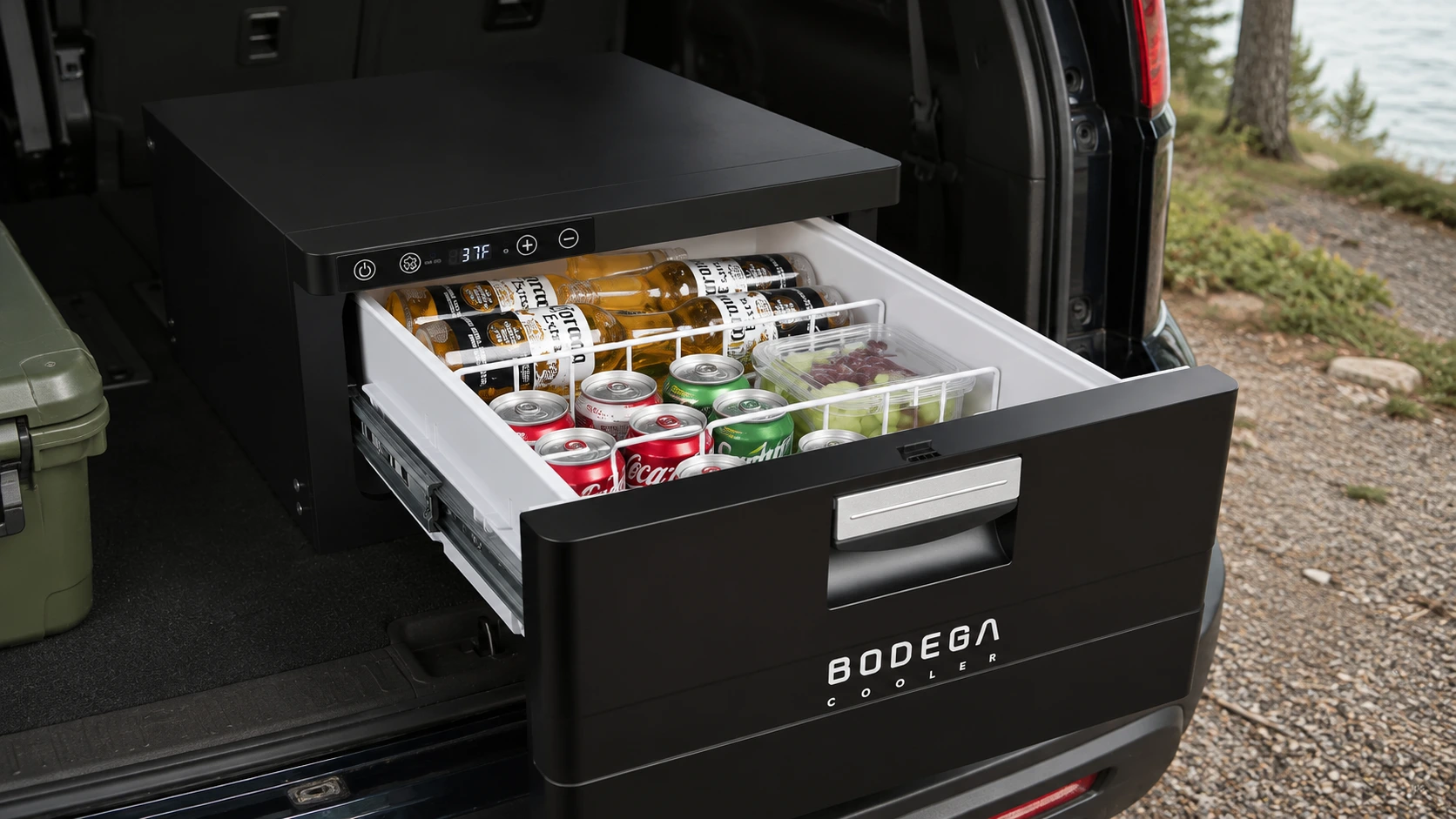
A low-profile 31-liter compressor drawer designed for built-in truck, van, and RV installations where front access works better than a top-opening lid.
BrandBODEGAcooler
Cooling
- Capacity
- 33 qt (31 L)
- Cooling type
- Compressor
- Zone configuration
- Single zone
- Temperature range
- -4°F to 68°F
- Cooling modes
- MAX and ECO
Installation and access
- Exterior dimensions
- 28.8 × 17.3 × 9.8 in
- Weight
- 43 lb
- Installation type
- Built-in drawer
- Drawer hardware
- Metal slide rails and hidden latch
- Included installation items
- Brackets, bolts, nuts, and bare-wire leads
Power and controls
- Power input
- 12/24V DC
- App control
- Yes
- Display
- LED control panel
- Vehicle-use features
- Anti-shake design and front drawer access
Best for
- Sleeper cabs, vans, and RV cabinets with limited vertical clearance
- Permanent or semi-permanent installations
- Users who want access without lifting a chest-style lid
Not ideal for
- Moving the fridge between vehicles and home
- Temporary cargo-area setups
- Buyers who need a dual-zone refrigerator
Pros
- Low-profile drawer layout
- 31-liter capacity in a built-in format
- App control
- Secure latch and smooth metal rails
- Front access works beneath counters or stacked cargo
Cons
- Requires installation planning
- Not designed for easy carrying
- Drawer travel needs clear space in front
- Single-zone interior
Choose it for a permanent low-profile bay. Skip it when portability and easy removal matter.
Chest example: Dometic CFX2 37L
The Dometic CFX2 37L represents a premium mid-size chest. It provides 37 liters in a 26.7 × 15.8 × 16.9-inch body, supports DC and AC power, and includes app control.
The chest is shorter in depth than the drawer but much taller, and the lid needs additional vertical room. At 34.8 pounds it is lighter and easier to remove, although a loaded cabinet is still substantial.
Product profile
Dometic CFX2 37L Portable Refrigerator and Freezer

A premium mid-size single-zone compressor cooler with vehicle and household power inputs, app control, and a reinforced portable body.
BrandDometic
Cooling
- Capacity
- 37 L (about 39 qt)
- Cooling type
- Compressor
- Zone configuration
- Single zone
- Temperature range
- -7°F to 68°F
Size and fit
- Exterior dimensions
- 26.7 × 15.8 × 16.9 in
- Weight
- 34.8 lb
- Published can capacity
- Up to 48 standard cans
Power and controls
- Power input
- 12/24V DC; 100–240V AC
- Rated current
- 8.7A at 12V; 3.85A at 24VRated current is not the same as average energy consumption.
- Battery protection
- 3-stage
- App control
- Yes
- USB output
- 5V / 2A
- Internal battery
- None
Best for
- Premium mid-size vehicle installations
- Road trips and overlanding with reliable DC or AC power
- Buyers who want app control without moving to a dual-zone cabinet
Not ideal for
- Running away from an external power source without a separate battery
- Keeping frozen and refrigerated items at two temperatures
- Very small cargo areas
Pros
- Practical 37-liter capacity
- Vehicle and household power cables included
- App control and USB charging port
- Three-stage battery protection
- Reinforced portable construction
Cons
- No internal battery
- Single-zone interior
- Larger and heavier than compact 20- to 30-liter models
Choose it when the vehicle can provide top access and the fridge needs to move between uses.
How should you measure for either layout?
For a chest, record:
- installed width and depth;
- closed height;
- open-lid height;
- hinge direction;
- slide dimensions, if used;
- vent and cable clearance;
- hatch opening.
For a drawer, record:
- cabinet opening width, height, and depth;
- full drawer extension;
- aisle or seat clearance;
- mounting surface;
- rear ventilation;
- cable path;
- ability to remove the fridge for service.
Measure the narrowest points. Trim, door angles, and furniture edges can be more restrictive than the nominal cabinet opening.
Common layout mistakes
- Choosing a drawer only because it is low. Depth and front travel may be the true limits.
- Choosing a chest only by closed height. The lid needs room.
- Stacking cargo on a chest lid. Access and latch operation become difficult.
- Building the drawer bay before selecting the exact model. Vents and dimensions differ.
- Ignoring loaded drawer leverage. The mounting structure must support the open position.
- Using a slide without a positive latch. The fridge can move under braking.
- Hiding the power plug behind permanent cabinetry. Inspection and disconnection remain necessary.
- Treating app control as a substitute for physical access. Cleaning and service still require removal.
FAQ
Does a drawer fridge keep cold air better than a chest?
Both can be efficient when designed well. A chest loses less dense cold air when opened from the top, while a drawer exposes more of the interior. Insulation, compressor control, opening time, and seal quality matter more than one simple rule.
Can a drawer fridge be used without mounting it?
It may power on, but the drawer action and weight are designed around a secured cabinet. Use the installation method in the manual rather than operating it loose in a vehicle.
Can a chest fridge go under a bed platform?
Yes, when the platform provides lid or slide access, ventilation, cable space, and restraint. Closed height alone is not enough.
Is a drawer fridge harder to clean?
It can be, because the cabinet is mounted and the shallow drawer may not lift out. Access to the drain and liner depends on the model. A removable chest basket is usually simpler.
Which layout is better for bottles?
A chest generally accepts taller items. A drawer may limit bottle height but keeps smaller containers visible and organized.
Do drawer fridges use more power?
Form factor alone does not determine energy use. Insulation, compressor system, ambient temperature, setpoint, ventilation, and use pattern matter.
Can I convert a chest fridge into a drawer setup?
A slide can pull a chest forward, but the lid still opens upward. That is different from a true front-opening drawer and often requires more total space.