

Quick answer
A 12V fridge that keeps turning off is usually losing stable input power, reaching its low-voltage cutoff, overheating, or receiving an intermittent connection. Test it from a known-good source with the shortest correct cable before changing settings or assuming the compressor has failed.
Repeated shutdowns are different from normal compressor cycling. During normal operation, the compressor stops when the cabinet reaches the set temperature, while the display and controls remain powered. A problem shutdown may blank the display, show an error, restart the whole unit, or stop cooling for an unusually long period.
The pattern is the clue. A fridge that stops only when the engine is off points toward outlet behavior or battery voltage. A fridge that restarts when the plug is touched points toward the connection. A fridge that runs indoors but fails in a packed vehicle may be overheating. A fridge that stops through an inverter but works on direct DC may be exposing a conversion or surge problem.
Do not lower the battery-protection setting, install a larger fuse, or add a splitter before identifying the cause. Those changes can hide the symptom while increasing the risk to the wiring or starting battery.
Fast diagnosis
Start with these checks:
- Is the display completely off, or is only the compressor off?
- Does the fridge show an error code?
- Does it stop when the engine is turned off?
- Does the plug or socket feel loose or hot?
- Does the fridge run correctly from household AC or another known-good source?
- Does it shut down when another device is connected to the same outlet?
- Are the compressor vents blocked?
- Is the battery-protection setting appropriate for the source?
- Does the voltage at the fridge fall when the compressor starts?
- Has the fridge been rapidly restarted after power loss?
Write down the conditions before changing anything. An intermittent fault is much easier to diagnose when the timing and source are known.
Is the compressor simply cycling normally?
A compressor fridge does not run continuously under normal refrigerator conditions. It starts, cools the cabinet, and stops until the temperature rises.
Normal cycling usually looks like this:
- display stays on;
- temperature reading remains visible;
- no error appears;
- compressor restarts after the cabinet warms;
- food temperature remains within the intended range.
A shutdown problem may look like:
- display goes dark;
- the unit reboots;
- an error code appears;
- compressor starts and immediately stops;
- cooling does not resume as temperature rises;
- the plug or adapter loses power;
- the unit works only when the cable is held in one position.
Use an independent thermometer when the control display is ambiguous. The 12V Fridge Not Cooling guide addresses temperature problems when power remains stable.
Does the vehicle outlet switch off with the ignition?
Many vehicle outlets are switched. They operate in accessory or run mode and shut off after the ignition is turned off. Others remain live and can drain the starting battery.
Test the outlet with the vehicle manual or a meter rather than assuming from one short observation. Some vehicles delay shutdown for several minutes. Others use battery-management logic that disconnects accessories later.
If the fridge stops at the same time the outlet turns off, the fridge is behaving normally. The solution is a different approved power source, such as a power station or properly installed auxiliary circuit—not a lower fridge cutoff setting.
Do not leave the ignition in accessory mode solely to power the fridge without understanding the vehicle’s battery behavior.
Is low-voltage protection shutting the fridge down?
Portable fridges commonly offer high, medium, and low battery-protection settings. The fridge monitors input voltage and stops the compressor when voltage falls below the selected threshold.
A high setting preserves more source voltage and is generally the conservative choice for a starting battery. A lower setting allows deeper use and may suit a dedicated battery, depending on chemistry and management system.
Low-voltage shutdown can occur because:
- the source battery is discharged;
- the source voltage sags under load;
- the cable is long or undersized;
- the plug is loose or corroded;
- the outlet wiring is marginal;
- another device shares the circuit;
- the threshold is high relative to the system voltage.
Measure voltage at the fridge while the compressor starts. A healthy battery can show good voltage at its terminals while a poor cable path delivers much less to the appliance.
Do not lower the cutoff until the source and voltage drop have been checked. The setting is not intended to compensate for a bad connection.
Is the cable causing voltage drop?
Every cable and connector has resistance. Longer length, smaller conductors, loose contacts, heat, corrosion, and multiple adapters increase the voltage lost between battery and fridge.
The symptom often appears at compressor startup because current rises. The fridge may attempt to start, detect low voltage, stop, and try again later.
Inspect:
- cable length and rating;
- plug fit in the socket;
- fuse holder;
- adapter joints;
- extension connectors;
- bends or crushed sections;
- corrosion or discoloration;
- heat at the plug after operation.
Test with the original short cable directly from a known-good source. If the problem disappears, add accessories back one at a time.
Is the plug loose in the 12V socket?
Vehicle-style accessory plugs are convenient but do not lock. Vibration can interrupt contact, particularly in worn sockets or on rough roads.
Signs include:
- display flickers when the plug moves;
- shutdown occurs on bumps;
- the plug backs out gradually;
- the socket or tip becomes hot;
- the fridge restarts when the connector is reseated.
Clean and inspect the socket according to the vehicle instructions. Do not wedge the plug with metal or modify it in a way that can short the circuit. A dedicated locking connector may be better for a permanent installation when the fridge and electrical system support it.
Is a splitter or second device overloading the circuit?
A 12V splitter creates more sockets, not more electrical capacity. The combined current still passes through the original outlet, wiring, splitter, and fuse.
A fridge may work alone and fail when a second device starts. Common combinations include:
- fridge plus tire inflator;
- fridge plus inverter;
- fridge plus heated appliance;
- fridge plus high-power USB charger;
- two compressor devices.
Add the loads and compare them with the lowest rating in the path. Remember that startup current can exceed steady running current.
The NOCO GC020 in the accessory section has a 15A total rating. That does not mean 15A is available at each socket, and it does not override a vehicle outlet rated below 15A.
Is an inverter shutting down?
When a fridge runs through an AC inverter, several protection systems can stop the chain:
- low battery voltage;
- inverter overload;
- insufficient surge capability;
- high temperature;
- idle or eco mode that does not detect the fridge load;
- loose AC connection;
- the fridge adapter’s own protection.
Test the fridge on direct DC if it supports it. If direct DC is stable, inspect the inverter settings, capacity, idle draw, and battery connection.
A runtime estimate does not prove that the inverter can start the compressor. Energy capacity and surge capability are separate.
Is an AC-to-DC converter undersized or overheating?
A converter used at home or at an AC campsite must support the fridge’s voltage, running current, and startup demand. It also needs ventilation.
If the converter stops:
- check its output rating;
- check whether the fan operates;
- remove other connected loads;
- inspect the output socket and plug;
- place the converter in open air;
- confirm the AC source is stable;
- look for an overload or temperature indicator.
Do not cover a converter with bedding or place it inside the fridge cabinet area.
Is the fridge overheating?
A compressor fridge rejects heat through its condenser and vents. If hot air cannot escape, the fridge may run longer, cool poorly, or activate thermal protection.
Check whether:
- a bag or blanket covers the vent;
- a fitted cover aligns with the vent openings;
- the fridge is inside a sealed drawer or cabinet;
- the fan is blocked by dust;
- the vehicle is closed in direct sun;
- the cabinet has the manual’s required clearances;
- the fridge is pressed against a wall on the compressor side.
Move the fridge to a ventilated location and test again. Do not remove safety covers or insert tools through the fan grille.
Is rapid restarting confusing the diagnosis?
Some compressor systems include a restart delay after power loss or after the compressor stops. Rapidly unplugging and reconnecting the fridge can extend the diagnostic confusion.
After correcting the source:
- turn the fridge off;
- disconnect power;
- wait the period specified in the manual;
- reconnect one stable source;
- allow the fridge to complete its startup sequence.
Do not repeatedly cycle power every few seconds.
Could the battery be weak even when it shows 12 volts?
A resting voltage does not show how the battery behaves under load. A weak or partially discharged battery can display a plausible voltage and sag when the compressor starts.
Battery condition, chemistry, temperature, state of charge, cable resistance, and connection quality all matter. Measure during operation and use the battery manufacturer’s guidance.
If the fridge is connected to the starting battery, the priority is preserving reliable engine starting. The article 12V Fridge Draining Your Car Battery explains that distinction.
Test the fridge from a known-good source
A controlled source test separates appliance problems from vehicle problems.
Use one source that is:
- within the fridge’s specified voltage;
- capable of the required current and startup demand;
- connected with the original or a short correct cable;
- not shared with other loads;
- placed in a ventilated location.
If the fridge runs normally, return to the vehicle setup and add one component at a time. If it still shuts down, record the error code, timing, temperature, and source details before contacting support.
Accessories that can solve a confirmed connection problem
The products below belong after diagnosis. They do not fix every shutdown and should not be used to bypass a weak circuit.
More reach from a suitable 12V outlet
The NOCO GC019 provides a 12-foot 15A extension. It is useful when the source is appropriate but physically distant. Extra length can increase voltage drop, so test the voltage at the fridge under load.
Product profile
NOCO GC019 12V Plug 12-Foot Extension Cable
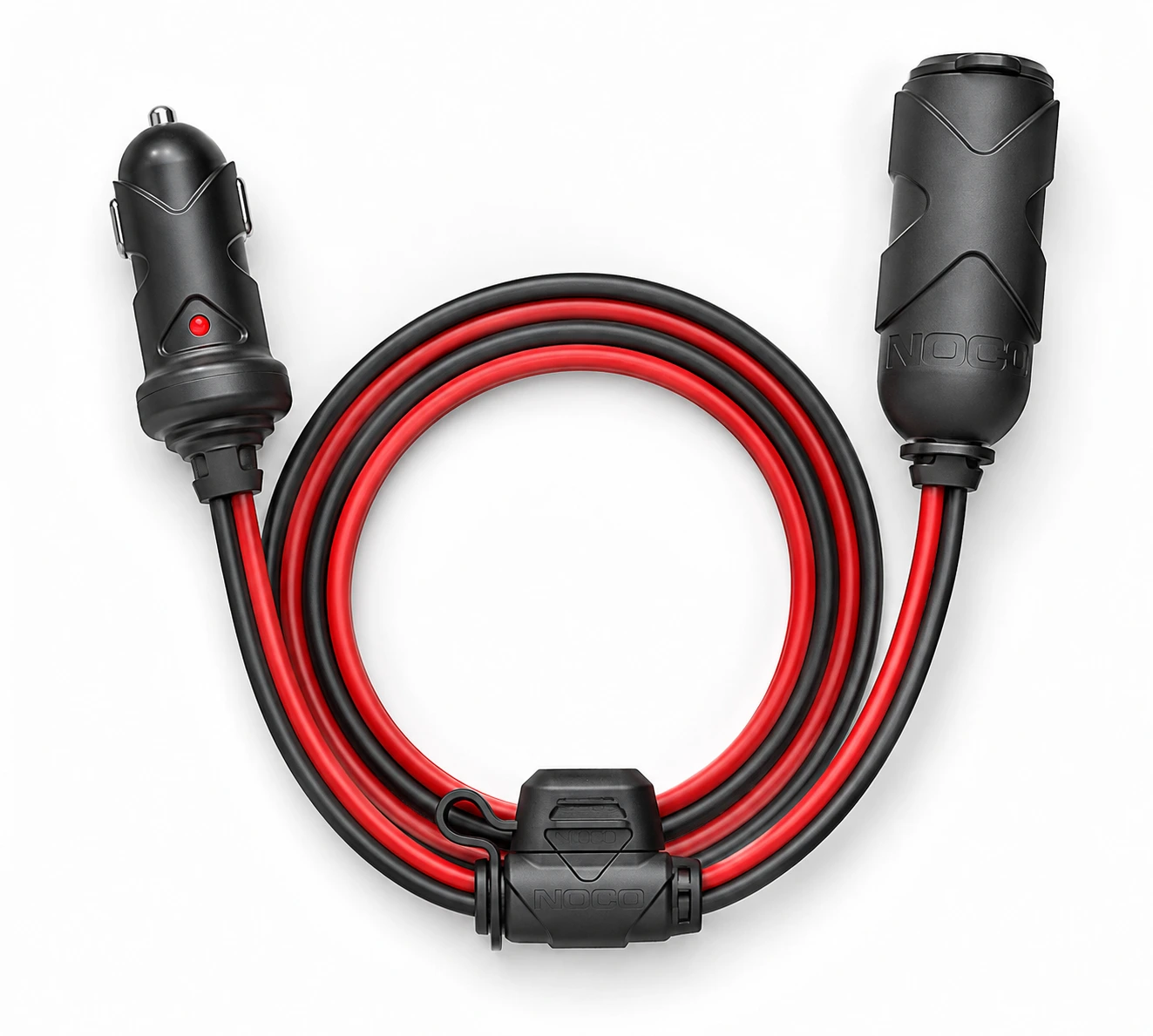
A fused 12-foot male-to-female 12V extension cable for adding reach between a vehicle or battery-powered accessory socket and a compatible portable fridge.
BrandNOCO
Connection
- Model
- GC019
- Input
- 12V male accessory plug
- Output
- 12V female accessory socket
- Cable length
- 12 ft (3.7 m)
Electrical
- Rated current
- 15 A
- Wire gauge
- 16 AWG
- Fuse
- 20 A mini-blade fuse
- Conductor
- Copper
Construction
- Socket protection
- Water-resistant cap
- Power indicator
- LED
- Connection style
- Male-to-female plug and socket
Best for
- Extending a 12V outlet to a portable fridge in a larger vehicle or campsite
- Temporary installations where a direct hardwired connection is not needed
- 12V devices that stay within the cable and outlet current limits
Not ideal for
- Loads above the 15 A cable rating
- Permanent hardwired installations
- Setups where a locking connector is required
Pros
- Adds 12 feet of reach
- Integrated fuse protection
- Water-resistant cap on the female socket
- LED shows when the socket is powered
Cons
- Extra cable length can increase voltage drop
- Uses a non-locking accessory plug and socket
- The vehicle or source outlet must still support the connected load
A fused socket from a compatible auxiliary battery
The NOCO GC018 adds a female accessory socket through eyelet terminals. It is appropriate only when the terminal size, polarity, fuse, cable routing, and battery system are suitable.
Product profile
NOCO GC018 12V Socket Adapter with Eyelet Terminals
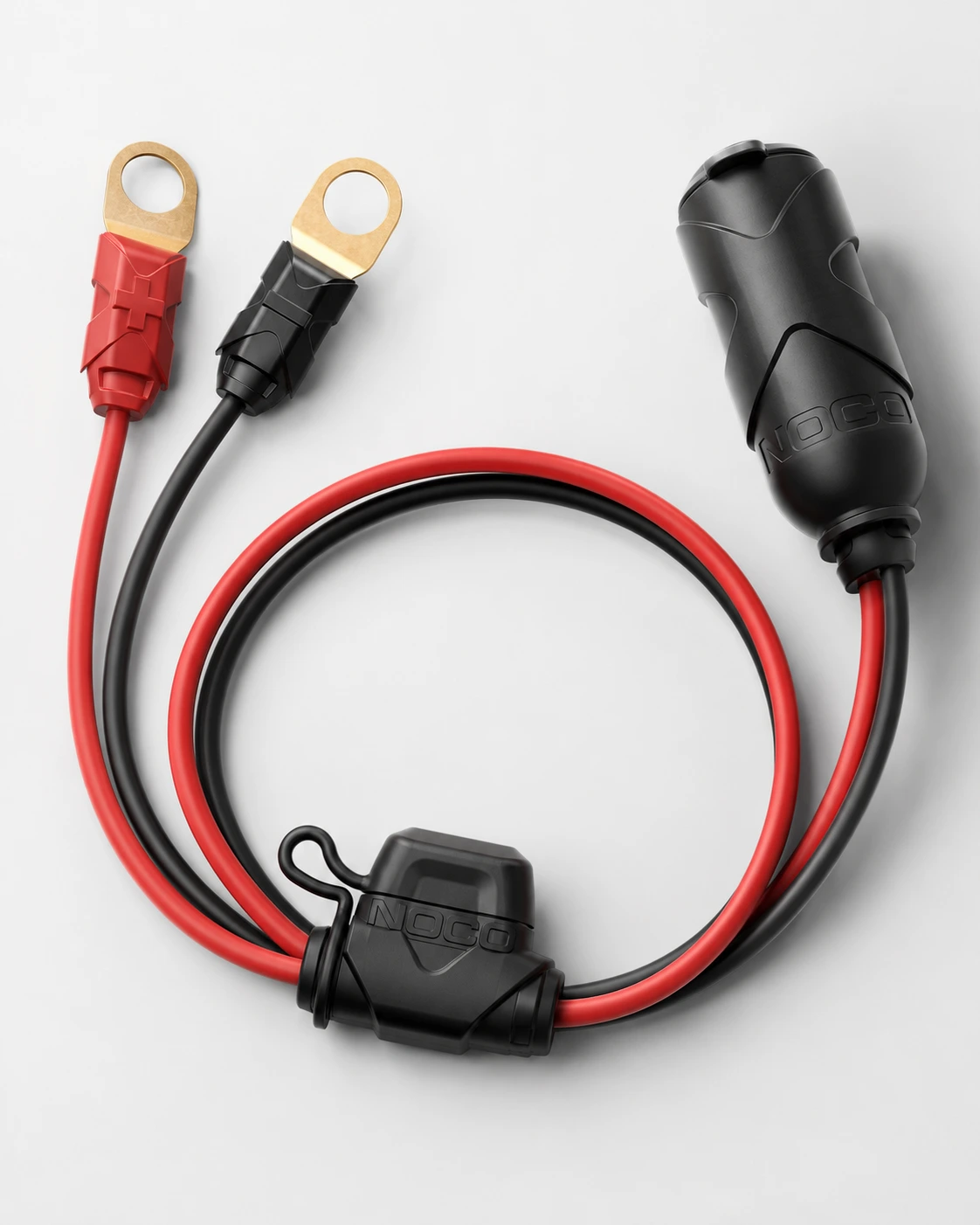
A fused eyelet-to-12V-socket adapter for creating an auxiliary accessory outlet from a compatible 12V battery terminal connection.
BrandNOCO
Connection
- Model
- GC018
- Battery connection
- M10 / 3/8-in eyelet terminals
- Output
- 12V female accessory socket
- Length
- 24 in cable; 28 in overall
Electrical
- Rated current
- 15 A
- Wire gauge
- 16 AWG
- Fuse
- 20 A mini-blade fuse
- System voltage
- 12V
Construction
- Socket protection
- Water-resistant cap
- Installation style
- Fixed eyelet-terminal connection
Best for
- Adding a fused 12V socket to a compatible auxiliary battery
- Portable-fridge setups that need a short fixed battery connection
- Users who can verify terminal size, polarity, fuse placement, and load limits
Not ideal for
- Temporary clamp-on connections
- Battery terminals that do not accept M10 / 3/8-in eyelets
- Loads above the 15 A rating
Pros
- Creates a dedicated 12V female socket
- Integrated fuse protection
- Compact cable length
- Water-resistant socket cap
Cons
- Requires a direct battery-terminal installation
- Not a quick removable clamp connection
- Terminal compatibility and safe routing must be checked before use
Household AC to 12V DC
The AstroAI converter supplies a 12V accessory socket from AC power, within its 15A/180W limit. It can help when the fridge works on DC but needs a home or campsite AC solution.
Product profile
AstroAI 15A 180W AC-to-DC Converter

A household-AC to 12V DC converter with a cigarette-lighter-style output socket for running compatible portable fridges and other 12V devices within its 15A and 180W output limits.
BrandAstroAI
Power conversion
- Input
- 100–240V AC, 50–60 Hz
- Output
- 12V DC
- Maximum output
- 15 A / 180 W
- Output socket
- 12V female accessory socket
Physical details
- Cable length
- 8.25 ft
- Converter dimensions
- 6.3 × 3.38 × 2.18 in
- Cooling
- Built-in fan
- Wire construction
- Copper conductors
Best for
- Running a compatible 12V fridge from household AC power
- Garage, home, or campsite hookups where a 12V socket output is convenient
- Devices whose operating and startup requirements remain within 15 A and 180 W
Not ideal for
- Devices that require more than 180 W or 15 A
- Wet or exposed outdoor locations
- Fridges that use a proprietary connector instead of a 12V accessory plug
Pros
- Full 15 A / 180 W output rating
- Accepts a broad 100–240V AC input range
- Long combined cable reach
- Built-in cooling fan
Cons
- Adds conversion loss compared with direct DC operation
- The converter and fan add bulk to the setup
- Fridge startup demand and plug compatibility must be checked separately
Two sockets from one circuit
The NOCO GC020 splitter is useful only when the combined load remains within the splitter and source ratings. It should not be used as a cure for an overloaded outlet.
Product profile
NOCO GC020 12V Plug 2-Way Splitter
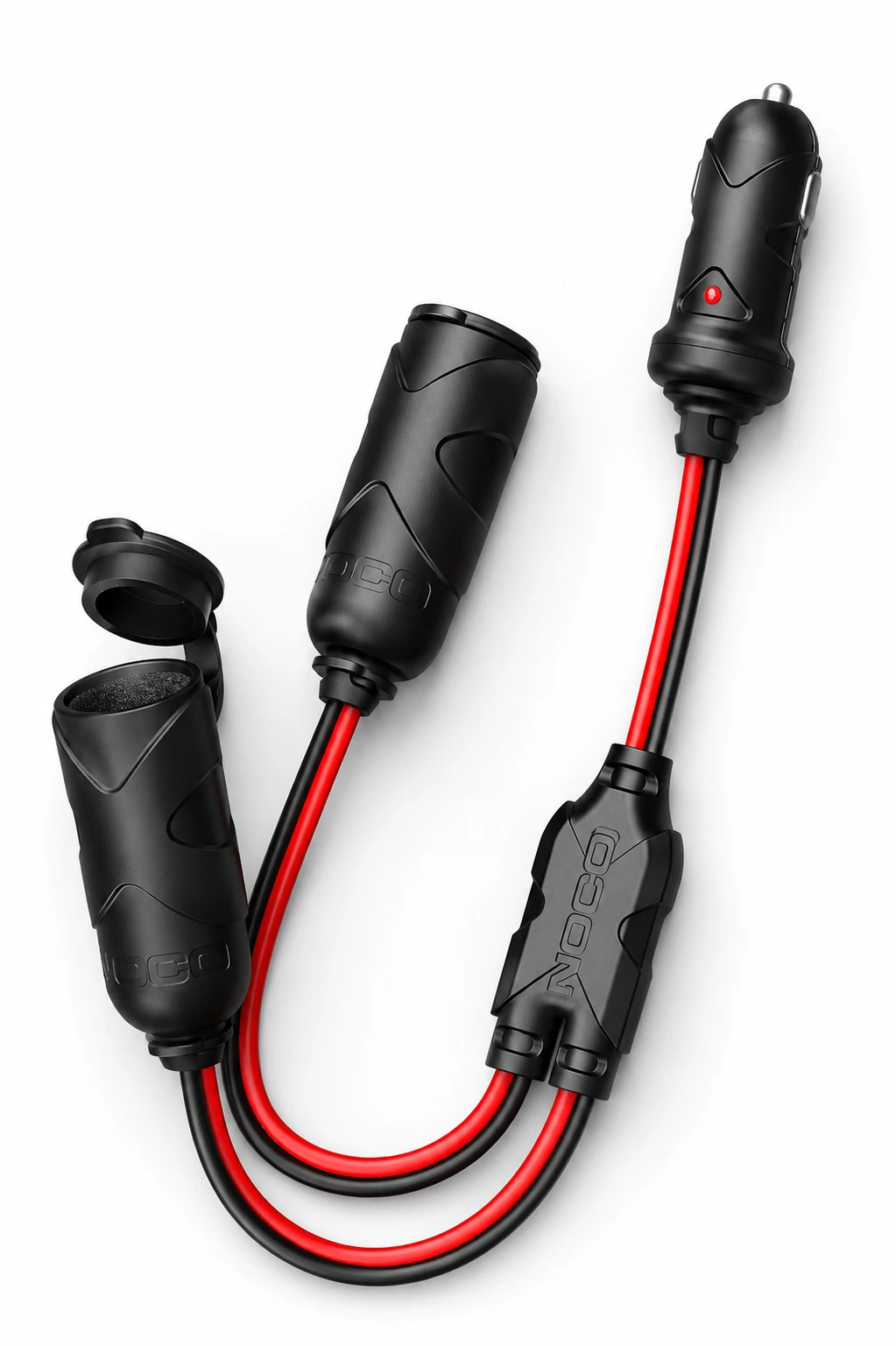
A fused 12V splitter that turns one vehicle-style accessory outlet into two sockets while keeping the total connected load within a 15-amp rating.
BrandNOCO
Connections
- Input
- One 12V male accessory plug
- Outputs
- Two 12V female accessory sockets
- Use
- Runs two compatible 12V accessories from one outlet
Electrical
- Total current rating
- 15A shared across both outputsThe splitter does not increase the rating of the vehicle outlet, wiring, or fuse.
- Wire size
- 16 AWG copper
- Fuse
- Integrated 20A micro-blade fuse
Construction
- Cable spacing
- 6.3 in from input to outputs; up to 10.6 in between output ports
- Socket protection
- Water-resistant cap
- Environmental resistance
- Designed to resist dirt, water, oil, and gasoline exposure
Best for
- Running a portable fridge alongside a low-draw 12V accessory
- Separating two accessory plugs in a vehicle or campsite setup
- Users who need a fused, branded splitter rather than an unmarked adapter
Not ideal for
- Powering two high-draw devices at the same time
- Exceeding the vehicle outlet or fuse rating
- Permanent hardwired installations
Pros
- Two 12V outputs
- 15A-rated 16 AWG construction
- Integrated fuse
- Water-resistant cap
- Flexible spacing between sockets
Cons
- 15A is shared rather than available to each outlet
- Does not solve an undersized or switched vehicle outlet
- Adds another connection point that should be kept secure
When should you contact support?
Contact the fridge manufacturer or qualified service provider when:
- the unit shuts down on several known-good compatible sources;
- an error code persists after the documented reset;
- the fan or compressor makes abnormal mechanical sounds;
- the plug, cable, or cabinet shows heat damage;
- the control panel reboots with stable input voltage;
- the fridge trips a correct fuse repeatedly;
- the compressor never restarts after the documented delay;
- refrigerant-system work may be required.
Do not open the refrigeration circuit, bypass internal protection, or replace a fuse with a larger value.
Common troubleshooting mistakes
- Lowering battery protection first. This can hide voltage drop and reduce starting-battery reserve.
- Testing only at the battery terminals. Measure at the fridge during startup.
- Adding a splitter to an overloaded outlet. More sockets do not add current capacity.
- Assuming a power station display proves the cable is good. The voltage can be lost after the display.
- Repeatedly unplugging the fridge. Compressor restart delay can make the problem appear worse.
- Calling normal compressor cycling a shutdown. Check whether the display and temperature remain stable.
- Ignoring heat. A packed cabinet can trigger protection even with perfect power.
- Replacing the product before testing another source. A five-minute controlled test can prevent an unnecessary purchase.
FAQ
Why does my 12V fridge turn off when I stop the engine?
The vehicle outlet may be switched, or the source voltage may fall below the fridge’s protection threshold. Confirm the outlet behavior and battery voltage.
Why does it turn on and off every few seconds?
Rapid cycling often points to voltage drop, a loose connection, an undersized converter, or compressor restart protection. Test with a short cable from a known-good source.
Should I set battery protection to low?
Not until the source and wiring are understood. Low may be appropriate for some dedicated batteries, but it can reduce reserve when connected to a starting battery.
Can a long extension make the fridge shut down?
Yes. Length and connector resistance can reduce voltage at the fridge, especially during compressor startup.
Can a splitter cause shutdowns?
Yes. A second device may push the combined load beyond the outlet, fuse, or splitter rating.
Why does the fridge work on AC but not in the vehicle?
That pattern points toward the vehicle outlet, cable, battery voltage, protection setting, or connector. The refrigeration system is less likely to be the primary cause.
Why does it work in the morning but stop in the afternoon?
Higher ambient temperature, a hot closed vehicle, blocked ventilation, or greater compressor duty cycle can expose marginal power and cooling conditions.
Is the fridge broken if it turns off at the set temperature?
No. The compressor should stop when cooling demand is satisfied. A stable display and normal restart later indicate regular cycling.