

Quick verdict
The Anker SOLIX EverFrost 2 40L is the strongest all-around battery-powered cooler in this group because the selected kit combines a removable 288Wh battery, wheels, app control, and several charging methods. The BougeRV Rocky V3.0 is more compact and adds a removable divider for flexible dual-zone use. The WORX WX876L is the practical small option for short off-grid periods, especially for people already using WORX Power Share batteries.
A battery-powered cooler solves a specific problem: keeping food cold while the cooler is away from a running vehicle, household outlet, or separate power station. It does not eliminate energy planning. The battery has a finite capacity, charging takes time, and published runtime claims depend on temperature, setpoint, cabinet load, and test conditions.
These products are compressor refrigerators with batteries or battery interfaces, not passive ice chests. They can hold a set temperature without adding ice, but they also have more weight, more electronics, and more charging decisions than a conventional 12V fridge. The right choice depends on where the cooler will operate after it leaves the vehicle.
This guide compares the exact battery-equipped kits in the product catalog. It does not rank measured runtime, pull-down speed, noise, or battery longevity because those require controlled hands-on tests.
What makes a battery-powered cooler worth buying?
An included battery is valuable when it changes how the cooler is used. Examples include:
- carrying cold food from a vehicle to a picnic area;
- keeping groceries cold during a long stop with the engine off;
- running the cooler beside a tent or camp kitchen;
- moving between two vehicles without transferring a power station;
- using the cooler during a short outage;
- supporting a worksite or sports event away from an outlet.
The battery is less valuable when the fridge remains connected to a fused auxiliary circuit or power station at all times. In that case, the integrated pack adds cost and sometimes weight without increasing usable cooling capacity.
Compare the full system:
- battery capacity in watt-hours;
- whether the battery is included or optional;
- battery chemistry and replacement availability;
- charging inputs and maximum input limits;
- ability to run directly from DC or AC when the battery is empty;
- cabinet capacity and zone layout;
- loaded weight and how the cooler is moved;
- whether the battery can be removed for charging or storage.
Quick picks
As an Amazon Associate I earn from qualifying purchases.
- Best all-around battery-powered coolerAnker SOLIX EverFrost 2 40L Cooler with Road Trip KitJump to pick
- Best compact dual-zone battery bundleBougeRV Rocky V3.0 41QT Dual-Zone Refrigerator with 240Wh BatteryJump to pick
- Best compact tool-battery coolerWORX WX876L 24QT Battery-Powered Cooler KitJump to pick
Battery-powered cooler comparison
| Option | Capacity | Zone layout | Exterior dimensions | Weight | Included battery | Power and charging | App control | Wheels |
|---|---|---|---|---|---|---|---|---|
| Anker SOLIX EverFrost 2 40L Cooler with Road Trip Kit | 40 L (42 qt) | Single zone | 39.0 × 18.1 × 19.7 in | 56.2 lb | One removable 288Wh LFP battery included | AC, vehicle DC, USB-C, or up to 100W solar | Yes | 6 in wheels with retractable handle |
| BougeRV Rocky V3.0 41QT Dual-Zone Refrigerator with 240Wh Battery | 41 qt (39 L) | Flexible dual zone | 28.7 × 17.7 × 15.8 in | 46.8 lb with battery bundle | Detachable 240Wh LiFePO4 battery included | 12/24V DC; 100–240V AC; 12–32V solar up to 150W | Yes | No |
| WORX WX876L 24QT Battery-Powered Cooler Kit | 24 qt (about 23 L) | Single zone | 26.2 × 15.4 × 13.9 in | 30 lb | Not listed | Two 20V Power Share batteries; 12/24V vehicle power; 100–240V AC | No | Yes |
Battery capacity is only the beginning of the runtime calculation
Battery capacity is listed in watt-hours because it represents stored energy. A 288Wh pack contains more nominal energy than a 240Wh pack, but that does not guarantee proportionally longer cooling. The cooler’s average load can differ, and the same product may consume far more energy in a hot vehicle or freezer mode than in mild weather at a refrigerator setpoint.
A useful planning relationship is:
usable battery energy ÷ average battery-side load = estimated runtime
The difficult part is average load. Compressor wattage is an “on” value. The compressor cycles, so daily use depends on duty cycle. A 50-watt compressor running 30 percent of the time averages about 15 watts before conversion and accessory loads. At 70 percent duty cycle, the same running wattage averages 35 watts.
Manufacturer claims may be valid under their stated conditions while being optimistic for a different trip. Look for:
- ambient temperature during the test;
- starting cabinet and food temperature;
- refrigerator or freezer setpoint;
- whether the lid stayed closed;
- whether a low-power mode was used;
- whether the claim covers one battery or two;
- whether charging input was connected during operation.
Use the 12V Fridge Runtime Calculator with a range rather than one exact result. Enter measured Wh/day after the cooler has been used in the actual environment whenever possible.
Best all-around battery-powered cooler
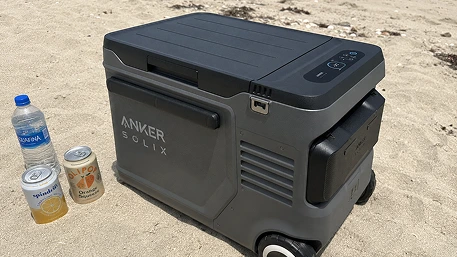
The Anker SOLIX EverFrost 2 40L Road Trip Kit offers the most complete integrated system in this group. The selected kit includes one removable 288Wh LFP battery, a 40-liter single-zone cabinet, six-inch wheels, a retractable handle, app control, and several charging paths.
The charging options are the main advantage. The cooler can accept household AC, vehicle DC, USB-C, or up to 100 watts of compatible solar input. That gives the owner several ways to keep the battery moving toward full, rather than depending on one proprietary charger at camp.
The battery is removable. That matters for storage and replacement, and it can allow the pack to be charged separately depending on the supported accessories. It also means the cooler is not tied permanently to one aging internal battery. The exact replacement cost and long-term availability should still be considered before treating the system as a decade-long purchase.
For everyday use, the battery compartment also simplifies transitions. The cooler can be pre-cooled on AC, moved into the vehicle without losing power, operated from DC while driving, and then rolled to a picnic table on its own pack. That sequence is the Anker’s strongest advantage over a conventional fridge plus a loose power station: there is no separate battery box to carry or cable to reconnect at every stop. The tradeoff is that the cooling system, wheel chassis, and battery ecosystem are tied together. If only one part no longer suits the trip, the owner cannot replace it as independently as a separate fridge and power station.
The 40-liter cabinet is single zone. It can operate as a refrigerator or freezer, but it cannot keep frozen meals and chilled produce at independent temperatures. The interior is large enough for meaningful road-trip food storage, yet the external body is much longer than many conventional 35- to 40-liter fridges.
At 39.0 × 18.1 × 19.7 inches and 56.2 pounds, the Anker needs a large loading path. The wheels and handle help on pavement, hard-packed campsites, and smooth floors. They do not make the cooler easy to lift over a bumper, carry up stairs, or move through deep sand. A user who plans frequent loading should check the height of the vehicle floor and whether two-person lifting is practical.
The long body has another practical effect: it needs room to turn. A cooler that rolls easily in a garage may be awkward between camp chairs, inside a van, or beside a narrow tailgate. The IPX3 water-resistance rating offers some protection from light spray, but it is not an invitation to leave the unit exposed in heavy weather. The retractable handle and six-inch wheels are most valuable when the route from vehicle to camp is smooth and reasonably wide. For a staircase, rocky trail, or deep sand, a shorter conventional fridge may be easier even without wheels.
Anker publishes cooling and runtime claims for the product family under stated conditions. Those claims are useful for understanding intended performance, but they should not be treated as a guaranteed trip duration. A freezer setpoint, warm food, a hot parked vehicle, and frequent opening can increase consumption substantially.
The cooler can continue operating from another supported input after the removable battery runs down. That is important: the product does not become useless when the pack is empty, provided a suitable DC, AC, USB-C, or solar source is available. A battery-powered cooler should always be evaluated in both states—battery available and battery depleted.
Product profile
Anker SOLIX EverFrost 2 40L Cooler with Road Trip Kit

A wheeled 40-liter single-zone compressor cooler with an included removable 288Wh battery and charging options for AC, a vehicle socket, USB-C, or solar.
BrandAnker SOLIX
Cooling
- Capacity
- 40 L (42 qt)
- Zone configuration
- Single zone
- Temperature range
- -4°F to 68°F
- Cooling modes
- MAX, ECO, and Smart
- Published fast-cooling claim
- 77°F to 32°F in 15 minutesManufacturer test used an empty cooler in MAX mode at 77°F ambient.
Battery and charging
- Included battery
- One removable 288Wh LFP battery
- Published runtime claim
- Up to 52 hours at 39°F with one batteryManufacturer test used an empty cooler in ECO mode at 77°F ambient; real runtime varies.
- Charging options
- Wall outlet, vehicle socket, USB-C, or up to 100W solar
- Solar input
- 12–30V; a battery must be installed while solar charging
- App control
- Yes
Size and mobility
- Exterior dimensions
- 39.0 × 18.1 × 19.7 in
- Weight
- 56.2 lb
- Mobility
- 6 in wheels and retractable EasyTow handle
- Water resistance
- IPX3
- Selected bundle
- 40L cooler, removable battery, and Road Trip Kit
Best for
- Trips where cooling must continue away from a parked vehicle
- Campers who want an included removable battery
- Buyers who value wheels, app control, and several charging methods
Not ideal for
- Small trunks or narrow cargo bays
- Buyers needing two independently controlled zones
- Frequent lifting into tall vehicles
Pros
- Included 288Wh removable battery
- Four charging methods
- Wheels and retractable handle
- App control
- Wide temperature range and three cooling modes
Cons
- Wide and heavy compared with conventional 35- to 40-liter fridges
- Single-zone interior
- Published runtime depends strongly on test conditions
- A second battery is not included
Choose the Anker when the cooler will regularly roll away from the vehicle and the included battery plus multiple charging inputs are worth the large body. Skip it when a compact footprint, dual-zone storage, or frequent lifting matters more than integrated mobility.
Best compact dual-zone battery bundle
The BougeRV Rocky V3.0 41QT is more compact than the Anker and uses a different interior strategy. Its 39-liter cabinet has a removable divider that can create two controlled zones or convert the interior into one larger compartment. The selected bundle includes a detachable 240Wh LiFePO4 battery.
The removable divider makes the Rocky more flexible for trips that change. A weekend may need one open refrigerator for meal containers; a longer route may need a small freezer compartment. That flexibility is only useful when the food actually fits both layouts. Two narrow zones can be less practical than one large bin even when the temperature control is technically more capable.
At 28.7 × 17.7 × 15.8 inches, the Rocky is much shorter than the Anker and about ten inches less long. The 46.8-pound bundle remains substantial, and there are no wheels. The cabinet is easier to fit in a vehicle but harder to move across a campsite once loaded.
That shape favors a semi-fixed installation. The cooler can sit beneath a lower shelf than the Anker and occupies less cargo length, which may leave room for another box or water container. The included battery still allows short off-vehicle use, but the absence of wheels means the owner must carry the full load or remove the battery and food first. Solar input up to the stated limit adds flexibility at a stationary camp, provided the panel, connector, voltage range, and sunlight match the cooler’s requirements. For moving camp every day, vehicle charging may be the more predictable part of the plan.
The power inputs include 12/24V DC, household AC, and compatible solar input. App control can help when the cooler is installed beneath a shelf. The published 80-watt rating is not the same as average consumption. In dual-zone mode with a cold freezer setting, the compressor may run more often than it would in a single refrigerator configuration.
The Rocky’s removable divider makes the battery more useful because the owner can change the thermal job. In one-zone mode, the cabinet can hold broad meal containers and operate at one moderate refrigerator temperature. With the divider installed, one side can handle frozen food while the other remains chilled, but the smaller compartments may force more frequent opening and tighter packing. The 240Wh pack is therefore not a fixed number of hours; the selected layout and setpoints can change the average load materially. Two removable baskets help organize either configuration and make it easier to lift food out without leaving the lid open for long.
The 240Wh pack has less nominal energy than the Anker’s 288Wh battery. The difference is not large enough to decide the purchase without considering average load. A smaller, well-insulated cabinet at a mild setpoint can outlast a larger cooler under harder conditions even with a smaller pack.
This is a newer product platform. That does not prove poor reliability, but it means the long-term battery ecosystem, replacement availability, and field history are less established than some mature portable-fridge lines. Buyers should separate the current feature set from assumptions about years of service.
Product profile
BougeRV Rocky V3.0 41QT Dual-Zone Refrigerator with 240Wh Battery

A 39-liter removable-divider fridge bundled with a detachable 240Wh battery, app control, and inputs for vehicle, household, or compatible solar power.
BrandBougeRV
Cooling
- Capacity
- 41 qt (39 L)
- Cooling type
- Compressor
- Zone configuration
- One open compartment or two zones with the divider installed
- Divider
- Removable
- Temperature range
- -4°F to 68°F
Battery and power
- Included battery
- Detachable 240Wh LiFePO4 battery
- Published runtime claim
- Up to 20 hours under specified conditionsRuntime depends on ambient temperature, setpoint, load, openings, and operating mode.
- Power input
- 12/24V DC; 100–240V AC; 12–32V solar up to 150W
- Rated power
- 80W
- App control
- Yes, with a published range up to about 32 ft
Size and construction
- Exterior dimensions
- 28.7 × 17.7 × 15.8 in
- Weight
- 46.8 lb with battery bundle
- Body
- Metal and plastic
- Baskets
- Two removable baskets
- Published noise level
- 45 dB or less
Best for
- Battery-supported overlanding without moving to a very wide cooler
- Travelers who want single- or dual-zone packing
- Users who may recharge from vehicle, AC, or compatible solar power
Not ideal for
- Buyers seeking a lightweight compact cooler
- Frequent one-person lifting
- Trips where a fixed single-zone interior is simpler
Pros
- Detachable 240Wh battery included
- Flexible single- or dual-zone layout
- Vehicle, household, and solar input options
- App control
- Two removable baskets
Cons
- Heavy for a 39-liter fridge
- No wheels
- Published runtime is conditional
- Newer product with a shorter long-term track record
Choose the Rocky when a compact battery bundle and removable-divider layout fit the trip better than wheels. Choose the Anker when roll-away mobility and a broader charging ecosystem are more important.
Best compact tool-battery cooler
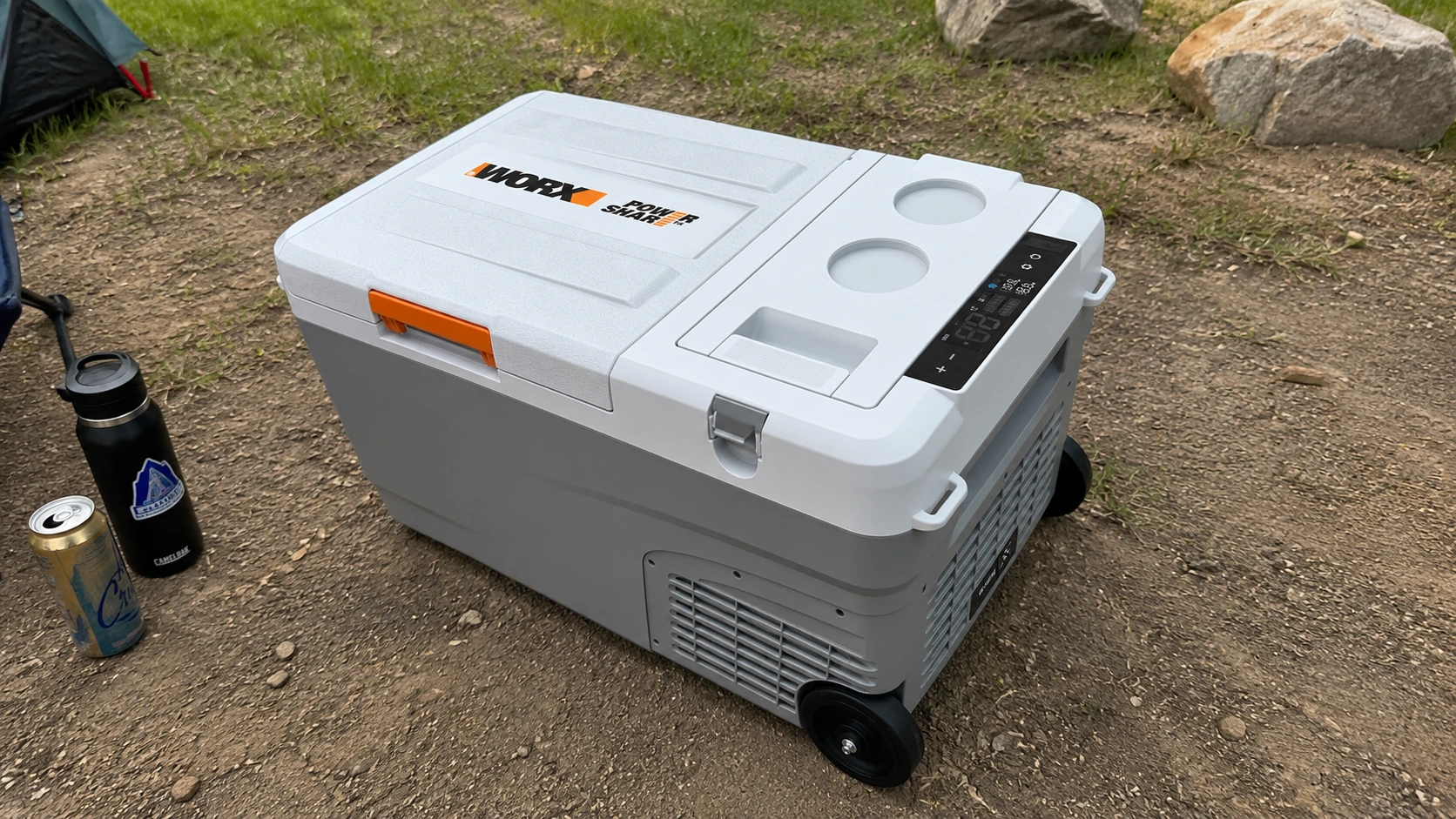
The WORX WX876L is the smallest battery-powered cooler in this group. Its 24-quart single-zone cabinet can run from two included 20V 4.0Ah Power Share batteries, vehicle DC, or household AC. It also has wheels, a pull handle, an interior light, and a USB output.
The battery system is the key difference. WORX owners may already have compatible packs and chargers, making it easier to rotate batteries between the cooler and tools. Buyers outside that ecosystem should treat the included batteries as a dedicated cooler system rather than assuming broad cross-brand compatibility.
The two-pack arrangement can also be easier to manage than one large proprietary battery. Each pack is small enough to remove and charge with the included charger, and an owner with other Power Share equipment may keep a spare pair ready. The downside is lower total energy than the dedicated 240Wh and 288Wh systems in this comparison. The published runtime should be treated as short-duration support, especially when the cabinet starts warm or operates as a freezer. Its real strength is not maximum endurance; it is the ability to bridge a lunch break, jobsite period, or transfer between vehicle and building without shutting the cooler down.
The 24-quart capacity is better for one person, a couple on a short outing, worksite drinks and meals, or a day away from the vehicle. It is not a substitute for a 40-liter family cooler. The smaller cabinet can also be an advantage: less food to cool, less space in the vehicle, and easier placement beneath cargo.
At 26.2 × 15.4 × 13.9 inches and 30 pounds, it is compact but not tiny. The wheels help on a hard surface, while the battery and wheeled chassis make it heavier than basic 20- to 24-quart compressor fridges.
Published battery runtime for tool-battery coolers is often shorter than for systems with a 240- or 288Wh pack. That does not make the WORX a poor product; it defines the use case. The batteries are a bridge for short off-grid periods, not necessarily an overnight solution in hot weather.
The cooler can switch to vehicle or AC power when the batteries are empty. A driver can use DC while moving, batteries during a stop, and AC at home. That sequence is more important than the maximum runtime claim in isolation.
The 24-quart cabinet and 30-pound empty weight make the WORX the easiest of the three to fit in a smaller vehicle, though the wheel and handle system still adds bulk compared with a basic chest fridge. An automatic interior light is useful when the cooler is opened at a worksite or in a dark cargo area, and the USB output can charge a small device. Both draw from the same batteries, so they should be considered part of the energy budget rather than free conveniences. This is the product for a buyer who values a familiar tool-battery ecosystem and compact mobility more than multi-day autonomous runtime.
Product profile
WORX WX876L 24QT Battery-Powered Cooler Kit
A compact wheeled single-zone compressor cooler that can run from two WORX Power Share batteries, a vehicle connection, or household AC power.
BrandWORX
Cooling
- Capacity
- 24 qt (about 23 L)
- Cooling type
- Compressor
- Zone configuration
- Single zone
- Temperature range
- -4°F to 68°F
- Published can capacity
- Up to 35 standard 12 oz cans
Battery and power
- Included batteries
- Two 20V 4.0Ah WORX Power Share batteries and charger
- Other power options
- 12/24V vehicle power and 100–240V AC
- Published battery runtime
- Up to 10 hours with two fully charged 4.0Ah batteriesActual runtime varies with temperature and usage.
- USB output
- Yes
- App control
- No
Size and mobility
- Exterior dimensions
- 26.2 × 15.4 × 13.9 in
- Weight
- 30 lb
- Mobility
- Roll wheels and heavy-duty pull handle
- Interior light
- Automatic LED
Best for
- Short trips away from vehicle power
- WORX Power Share owners
- Compact truck, beach, and picnic use where wheels help
Not ideal for
- Multi-day battery operation without recharging
- Dual-zone packing
- Buyers outside the WORX battery ecosystem
Pros
- Batteries and charger included
- Three power methods
- Compact 24-quart size
- Wheels and pull handle
- USB charging and interior light
Cons
- Shorter published battery runtime than larger 288Wh systems
- Single-zone interior
- Battery compatibility is tied to the WORX Power Share platform
Choose the WORX for compact short-duration battery use, especially when compatible batteries already exist in the household. Choose a larger dedicated battery cooler for longer off-vehicle operation or more food capacity.
How do included battery capacities compare?
The three systems use different battery arrangements:
- Anker: one removable 288Wh LFP pack in the selected kit;
- BougeRV: one detachable 240Wh LiFePO4 pack;
- WORX: two included 20V 4.0Ah Power Share batteries.
Tool-battery energy may be presented in amp-hours and voltage rather than one watt-hour total. The underlying conversion is volts × amp-hours, but nominal voltage and usable energy can differ from a simple marketing calculation. Use official pack information and avoid comparing amp-hours across different voltages.
Capacity should also be compared with cooler size. A 288Wh pack in a 40-liter cabinet and a smaller pack in a 24-quart cabinet are not performing the same thermal job. Setpoint, ambient temperature, and insulation can outweigh a modest difference in battery size.
What happens when the included battery is empty?
A good battery cooler should remain usable as a normal powered fridge. All three products in this guide support another power method:
- vehicle DC while driving;
- household AC at home or a powered campsite;
- supported charging inputs while the battery remains installed;
- compatible solar or USB-C on products that provide those inputs.
The trip plan should identify the next charging opportunity before the battery reaches empty. Waiting until the cooler shuts down leaves no margin for slower charging, cloud cover, a switched vehicle outlet, or an unavailable campsite receptacle.
When the battery is depleted, do not treat an ice-filled cabinet as an automatic fallback unless the manufacturer allows water and melting ice inside the product. A powered refrigerator is not necessarily designed as a drainable passive ice chest.
Should you buy a battery cooler or a fridge plus power station?
A battery cooler is cleaner as one integrated system. The battery is designed to fit the appliance, the controls can report its status, and there are fewer loose cables. It is easier to roll or carry one package away from the vehicle.
A fridge plus power station is more modular. The battery can power lights, phones, laptops, and other devices. The fridge and battery can be replaced separately. A larger power station can also provide much more energy than the included packs in these coolers.
Choose an integrated battery cooler when:
- cooling is the primary off-grid load;
- the cooler moves frequently;
- one-system convenience matters;
- the included charging options match the trip.
Choose a separate power station when:
- several devices share the battery;
- more runtime is needed;
- the fridge remains stationary;
- battery capacity should be upgraded independently;
- the power station already exists.
How should runtime claims be interpreted?
Read every runtime claim with its conditions. Ask:
- Was the cooler empty or loaded?
- Was the food already cold?
- What was the ambient temperature?
- Was the setpoint refrigerator or freezer?
- Was economy mode used?
- Was the lid opened?
- Was charging input disconnected?
- Was the test performed with one battery or an optional second pack?
A claim such as “up to 52 hours” can be accurate for a mild refrigerator test and still be unrealistic in a hot vehicle. It is not deceptive to publish a controlled best-case result when the conditions are stated; it is a mistake to reuse that result as a trip guarantee.
How should a battery cooler be charged on a trip?
A practical sequence may be:
- fully charge the pack from AC before departure;
- pre-cool the cabinet and food at home;
- operate from vehicle DC while driving;
- reserve the battery for parked or off-vehicle periods;
- recharge at camp or during the next drive;
- use compatible solar as supplemental input rather than the only plan unless conditions are dependable.
Charging from a vehicle should be tested with the engine running and parked. Some outlets shut off, and some cannot provide the claimed input continuously. Solar output varies with panel angle, shade, temperature, and controller limits.
Does a removable battery make the cooler lighter?
It can reduce the weight carried in one lift if the battery is removed first. The cabinet remains heavy, and not every product is designed to be carried without the pack installed. Remove the battery only as directed and protect its contacts.
The Anker’s wheels reduce ground handling effort. The BougeRV has no wheels, so removing the battery can matter more during lifting. The WORX uses two tool batteries that can be removed separately, but the cooler’s chassis still includes the wheel and handle system.
Single zone or dual zone?
Single zone provides one open compartment and one temperature. It is easier to pack with large containers and often provides more flexible usable space.
Dual zone supports separate setpoints when the compartments are independently controlled. It is valuable for frozen food, but the split can create narrow spaces. A removable divider offers both modes, though the interior may not be as open as a purpose-built single-zone cabinet.
The Anker and WORX are single zone. The Rocky uses a removable-divider dual-zone design. Choose based on the food plan, not the number of controls.
How much capacity should you choose?
Battery coolers should not be oversized simply because they can run away from the vehicle. Larger cabinets require more room and may contain more warm food during pull-down.
For short use:
- around 20–25 quarts can cover drinks and meals for one or two people;
- around 40 liters provides more flexible multi-day food storage;
- dual-zone layouts reduce the usable size of each compartment.
Use the Capacity Planner with days between resupply and actual drink size. Then check the external dimensions, because the battery and wheel system can make a 40-liter cooler much larger than a conventional fridge of similar capacity.
Battery care and storage matter after the trip
A removable pack adds maintenance questions that a basic externally powered fridge does not have. Follow the manufacturer’s storage-charge, temperature, and long-term storage guidance. Do not leave a battery in a closed hot vehicle for extended periods unless the product documentation permits those conditions.
Before storage:
- clean and dry the cooler;
- disconnect charging cables;
- inspect battery contacts;
- store the pack at the recommended state of charge;
- protect it from moisture and extreme temperatures;
- recharge or check it at the recommended interval.
Battery replacement availability should be part of the purchase decision. An otherwise functional cooler can lose much of its advantage if a proprietary pack is no longer available.
Common battery-cooler mistakes
- Comparing battery amp-hours without considering voltage.
- Treating a manufacturer runtime claim as a guarantee.
- Cooling warm groceries entirely from the battery when AC pre-cooling was available.
- Buying an integrated battery when a power station already solves the problem.
- Ignoring the cooler’s external dimensions and wheel chassis.
- Assuming wheels eliminate the lift into a vehicle.
- Using solar without checking the cooler’s input limits.
- Forgetting that app control and USB outputs consume some energy.
- Planning around one charging method.
- Storing the battery in extreme heat.
- Buying dual zone without checking compartment shape.
FAQ
How long does a battery-powered cooler run?
It depends on usable battery capacity and average cooler load. Mild refrigerator operation can last much longer than freezer use in hot weather. Use a range, not one exact figure.
Can the cooler run while its battery is charging?
Many models support simultaneous operation and charging, but the exact behavior and input priority vary. Follow the manual for the selected product and charging source.
Is a battery-powered cooler the same as a portable power station?
No. Its battery is integrated with or dedicated to the cooler. A power station is a general-purpose battery with multiple outputs for many devices.
Can I add ice when the battery runs out?
Only when the product documentation allows it. A compressor cooler may not be designed to hold melting ice like a passive chest.
Is LiFePO4 better for a cooler battery?
LFP batteries are commonly chosen for cycle life and thermal stability, but pack quality, management electronics, capacity, and replacement support also matter.
Do battery coolers work from a vehicle outlet without the battery installed?
The products in this guide support external power, but exact operation can vary. Confirm the manual and cable arrangement before relying on battery-free use.
Does a freezer setting reduce runtime?
Usually, because the cooler maintains a larger temperature difference and the compressor may run more often. The effect depends on ambient conditions and cabinet load.
Is the Anker 40L cooler dual zone?
No. The exact 40L Road Trip Kit in this guide is a single-zone model. Larger products in the family may use different layouts.